

# Educational Toys for 3-Year-Olds
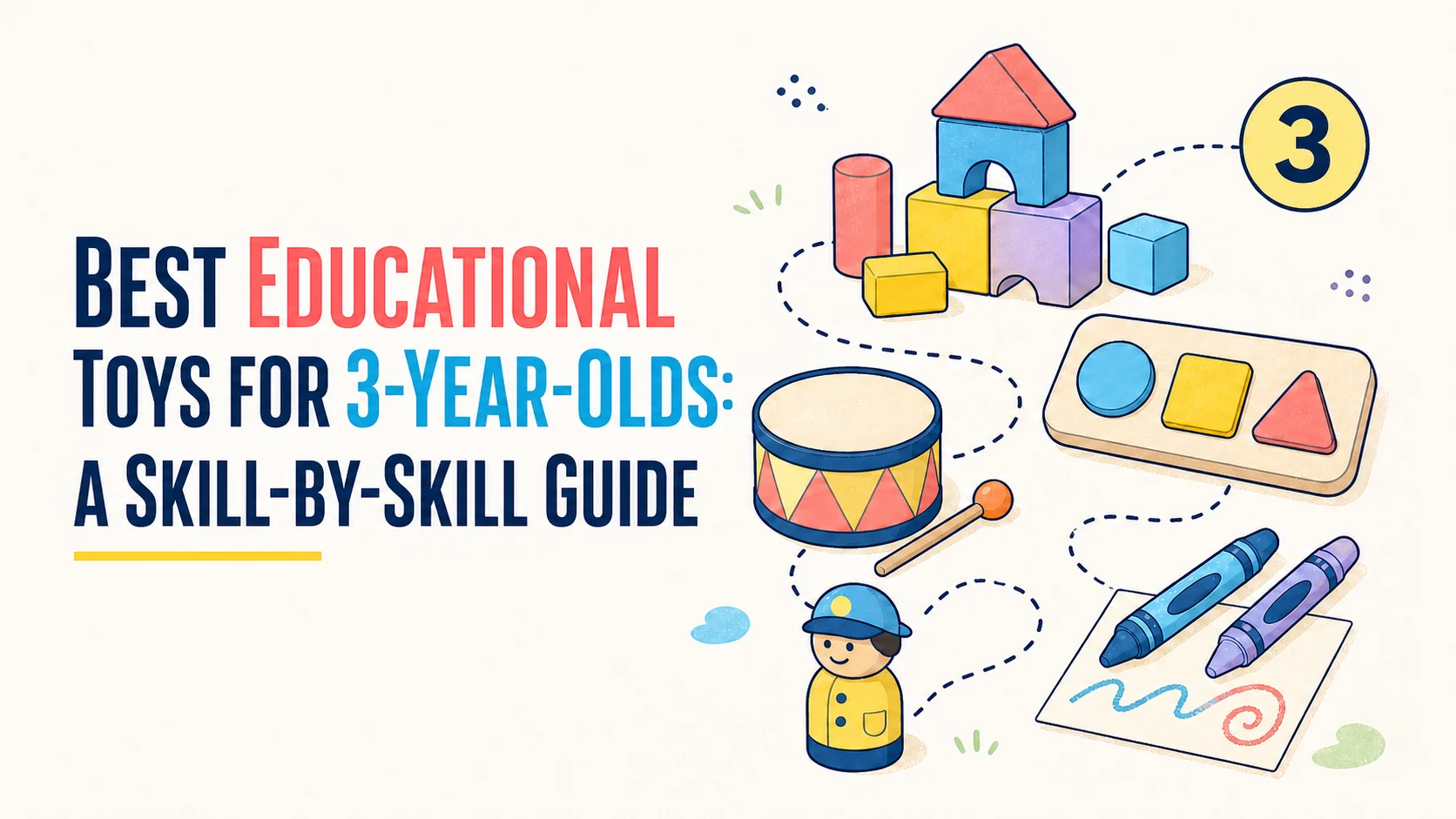
Useful educational toys make an interesting action easy to begin and leave room for the child to change the plan. Building pieces, pretend-play props, puzzles, art materials, instruments and matching games can all support learning through play when they fit the child's present abilities.
Quick answer
Choose for what the child can do: build, sort, name, draw, move, negotiate or make a sound. Look for a clear starting point, understandable feedback and more than one way to continue. The word “educational” on a box is not evidence of a better toy.
Start with observable play
Ask four questions. Can the child understand how to begin? Can they see what their action changed? Can the activity become a new structure, story or rule? Is setup, noise, cleaning and storage realistic for the home?
A useful challenge is neither effortless nor so difficult that every attempt needs adult rescue. No single product is required for a developmental milestone.
Language and pretend play
Figures, dolls, vehicles, play food, dress-up items and ordinary household props can invite conversation because the child supplies the story. Listen for naming, explaining, repeating routines and inviting another person to join.
Choose pieces large enough for the intended age and easy to identify. A small set of flexible props is often more usable than a crowded kit of single-purpose accessories.
Building and problem solving
Large-piece puzzles, construction sets and sorting materials create manageable problems with visible feedback. Check whether pieces are comfortable to grip, the base remains stable and a wrong piece can be removed without help.
Building supports experiments with balance, connection, size and sequence. The value comes from the process, not from a STEM badge or a claim on the packaging.
Safety checks in the UK
Read the complete label and instructions for the exact model. Check small parts, magnets, button batteries, cords, sharp edges, pinch points and damage. Consider younger siblings who share the space.
Use the UK government's product safety alerts, reports and recalls and follow the current product instructions. Stop use when wear creates a new hazard.
What a credible “best” list needs
A named recommendation should record model, sample source, test date, setting, easiest entry point, next challenge, setup, reset, cleaning, noise, storage and wear. Commercial relationships and limitations should be visible. Until this evidence exists, a category guide is more honest than a ranked verdict.
Related guidance
Browse the UK guides hub or use the Toy Finder to narrow by age and situation.
Frequently asked questions
Do electronic learning toys teach more?
Not necessarily. Electronic feedback can show cause and effect, but more features do not guarantee richer play.
How many educational toys does a three-year-old need?
There is no required number. A smaller accessible collection can be easier to use than an overfilled shelf.
What if the child uses the toy differently?
Check safety first. A safe unexpected use may reveal the child's real interest; an unsafe use means the toy should be removed.