


Choosing educational toys for 5-year-olds works best when you begin with what the child will actually do, then check challenge, agency, stories and replay value. This is a category guide, not a product ranking or a claim that Find Best Toys has tested every model. In the UK, verify the exact local product label, instructions, seller and current recall status before use.
Category: Age and learning · Tags: educational toys for 5-year-olds, Age and learning, British toy safety
Quick answer
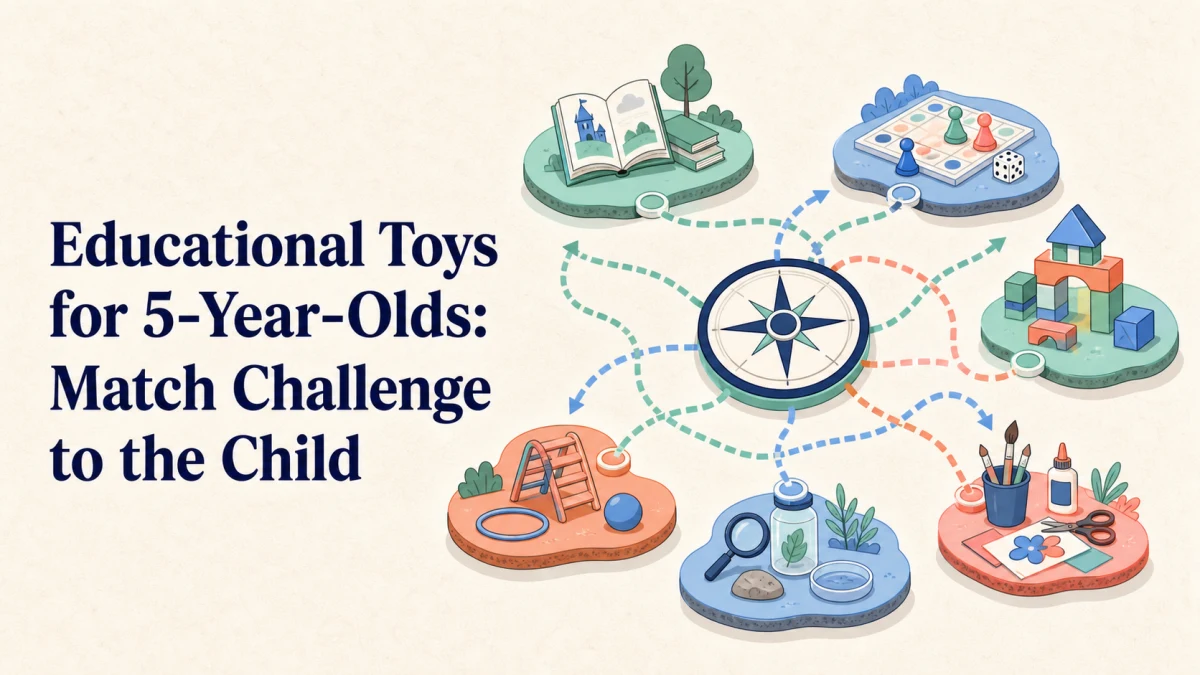
Shortlist a toy only when its first action is obvious, the child can repeat it with manageable help, and the activity fits the place where it will be used. Useful play routes for this category include storytelling, games with simple rules, building and hands-on investigation. More features do not automatically create more learning or longer play.
Start with one familiar action and one small next challenge. If the child cannot enter the play without a long explanation, or if an adult must continually reset the toy, save that option for later. A suitable choice should tolerate mistakes, invite another attempt and remain understandable after the novelty fades.
Build a practical shortlist
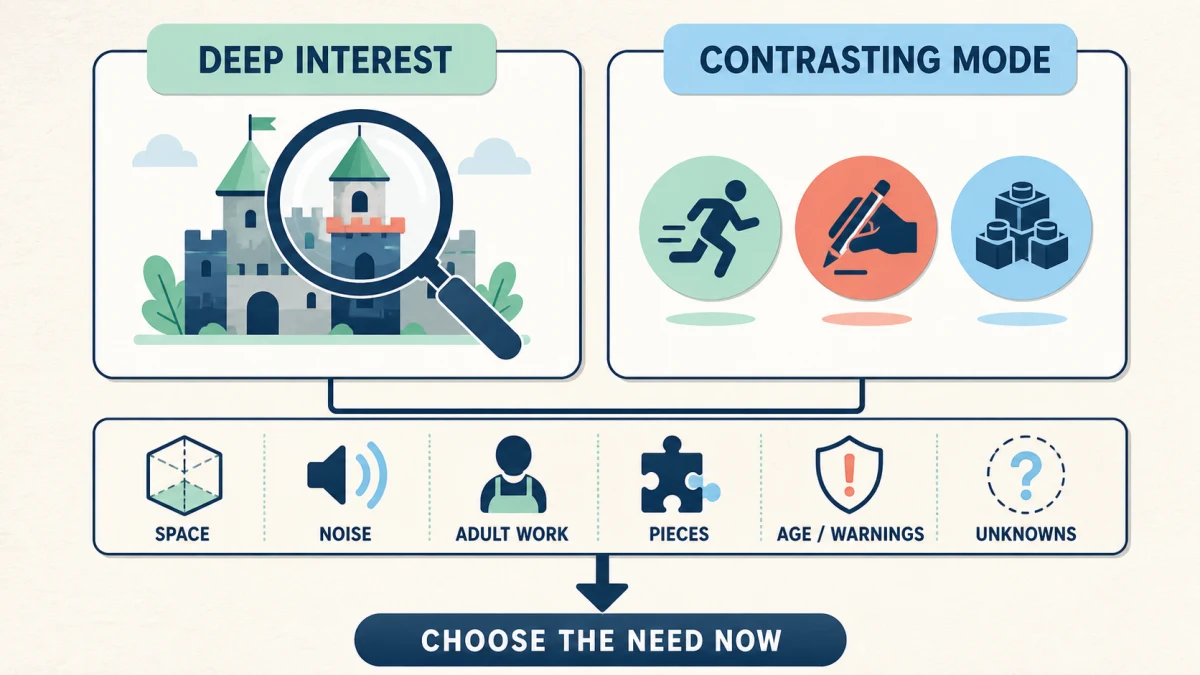
Compare no more than three formats at a time. For each one, write down the main action, the easiest successful entry, one way the child can vary the play and the work an adult must do. Then check challenge level, child-owned choices, adult setup and storage. Unknown model facts stay unknown until the maker's current documentation confirms them.
- Fit now: the child can begin without being tested or hurried.
- Room to grow: the play can become a little more complex without buying a large add-on system.
- Household fit: setup, noise, cleaning and storage are realistic for repeated use.
- Evidence boundary: packaging language is not proof of a developmental, calming or educational outcome.
Apply the Five-layer fit framework
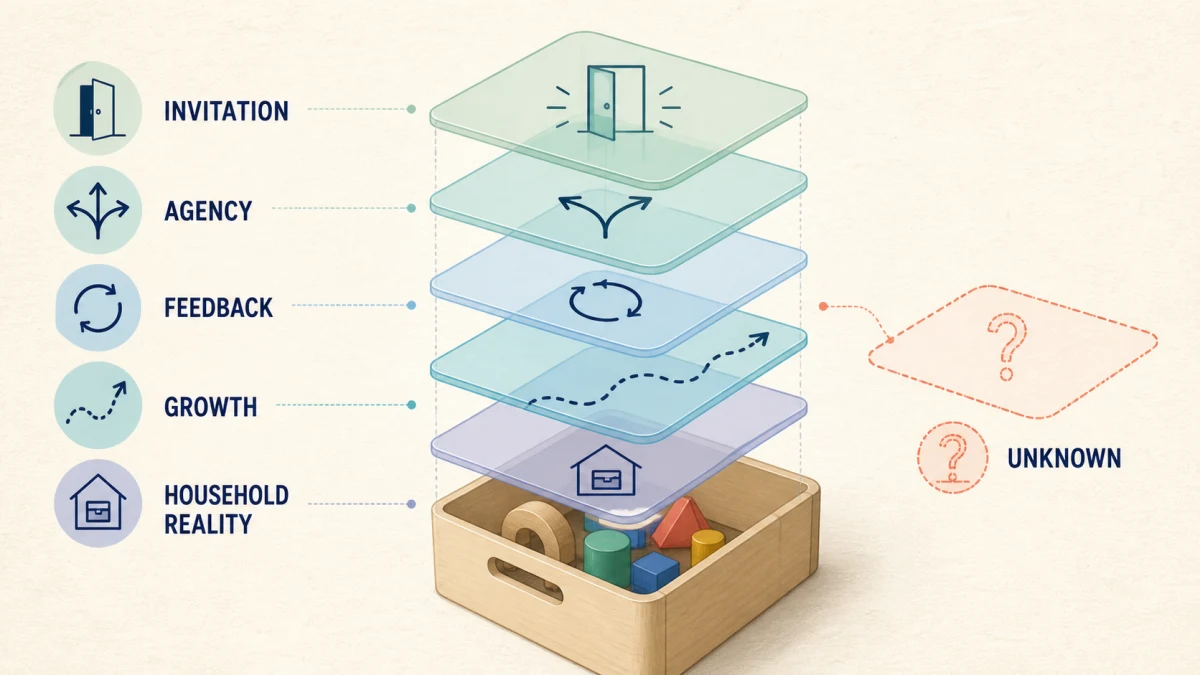
The en-US master names this the Five-layer fit framework. Apply its category-specific sequence to challenge level, child-owned choices, adult setup and storage; then name the main action, an accessible first success, one useful variation, failure recovery and the adult workload. If pieces scatter, batteries need frequent attention or the activity depends on a phone, include that burden in the decision.
Observe actual play instead of steering every move. Engagement may look like repeating, changing the plan, telling a story, solving a small problem or returning later. Walking away is also useful information. It may mean the challenge, sensory load or context is wrong today; it is not a reason to pressure the child.
Compare formats without inventing a winner
| Question | What to observe | What to verify |
|---|---|---|
| Is the first move clear? | The child can start with little explanation | Current age label and instructions |
| Can the play change? | The child varies storytelling or games with simple rules | Included parts and required add-ons |
| Is the challenge recoverable? | A mistake leads to another attempt | Stability, breakage and pinch points |
| Does it fit the household? | Noise, setup and tidying are manageable | Cleaning method, power and storage |
There is no universal best format. The useful comparison is between the child's current interests, the intended setting and the verified facts of the exact model. Avoid rankings based only on feature counts, advertising badges or a product photo.
Safety and recall checks in the UK
The en-US master uses dated US official sources for category-level hazards. Those sources do not replace British labels, requirements or recall action. Use UK Office for Product Safety and Standards to check local safety information and current notices, then follow the manufacturer’s instructions for the exact model sold in the UK.
Before the first play session, count every removable part, tug gently on attachments, inspect edges and seams, and check that any battery closure needs the method stated in the instructions. Stop using a toy when a part loosens, a surface cracks, filling escapes, a magnet or battery becomes accessible, or cleaning changes its construction. Do not improvise a repair that alters a safety feature.
Plan for the room, garden or shared setting actually available in a UK home, as well as damp storage and products bought through overseas marketplaces.
Care, storage and review
Keep the care label or a clear photograph of it. Clean only by the stated method, dry the item fully and inspect it again before returning it to play. Store all parts together and record anything that was discarded. For shared or second-hand toys, confirm the model identity and instructions rather than assuming a similar-looking version is equivalent.
Review the fit after a week of ordinary use. Ask whether the child initiates the play, whether the challenge can change, and whether the household can sustain the reset. A toy can be well made yet still be a poor fit for this child, room or season.
Related reading and next step
Read the related guide to educational toys for 6-year-olds, or browse the British Find Best Toys blog for other published, same-market articles. Use the guides hub to compare categories before looking at individual listings.
Frequently asked questions
Is this a ranking of products sold in the UK?
No. It is a decision framework for educational toys for 5-year-olds. It does not name a best model, claim hands-on testing or confirm price, stock or certification.
What should I verify on the exact product?
Check the local age label, warnings, instructions, parts, power system, cleaning method, seller identity and current recall status. Treat any missing fact as unresolved.
How many options should I compare?
Two or three formats are enough. Compare the play action, challenge, adult workload and verified model facts instead of counting features.
Does “educational” or “sensory” guarantee an outcome?
No. Those words describe a marketing category, not a guaranteed learning, calming or health result. Look for observable play and product-specific evidence.
When should the toy be retired?
Retire it when parts loosen, seams split, surfaces crack, filling leaks, power components become accessible, the item cannot be cleaned as directed or a recall notice requires action.