

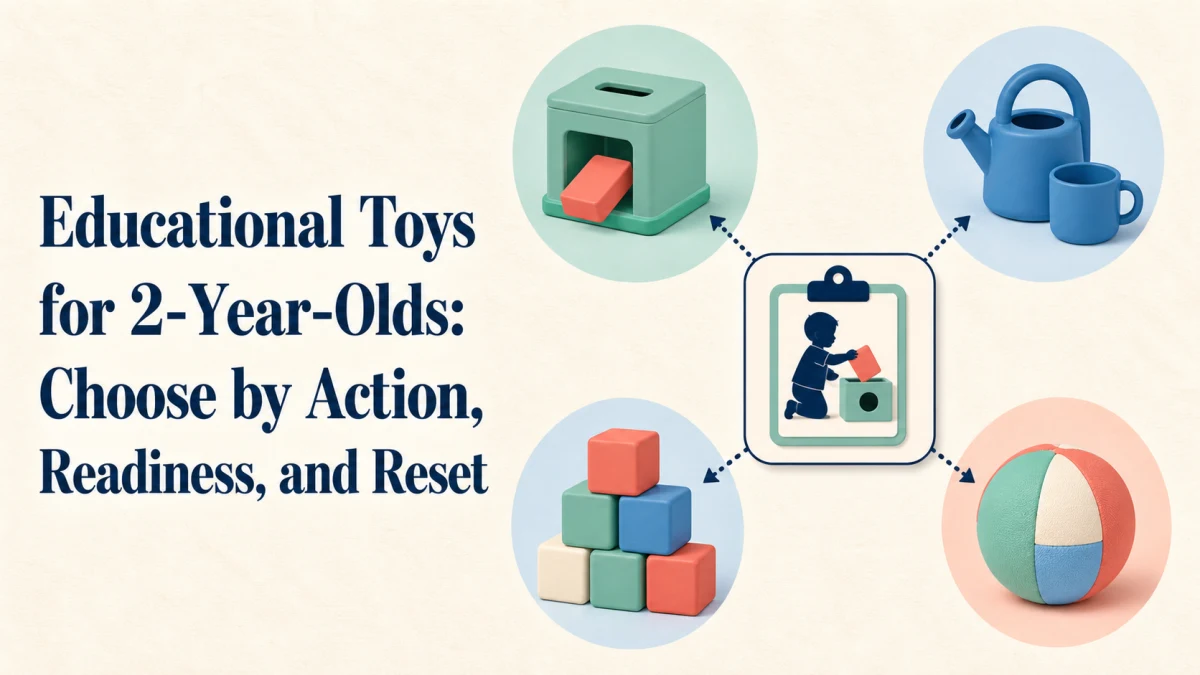
The best educational toys for 2 year olds are not a fixed product list. They offer an action a child can understand—fit, open, stack, match, push, pretend, carry, or build—at a challenge level that invites repetition without constant adult rescue. Start with the child’s current play, then check piece size, stability, effort, noise, cleanup, and how quickly the activity can reset. This guide compares toy *types* and decision criteria; it does not rank or claim to have tested individual products.
Key Takeaways
- Choose an observable play action instead of trusting a broad “educational” badge.
- Match the entry step to what the child can do now, with one small next challenge.
- Treat age labeling as essential safety information, not proof of learning value.
- Favor toys a child can repeat and vary without a long adult setup.
- Verify the exact model’s pieces, fasteners, battery enclosure, warnings, instructions, and current recall status before use.
What Makes a Toy Educational at Age Two?
At this age, learning is visible in the play. A child may hold a container while removing its lid, experiment with a switch, combine toy food with a plate, kick or roll a ball, name pictures, or copy an everyday action. Those are examples in the CDC’s age-two milestone and activity guidance, not a shopping checklist or a test a toy must make a child pass. CDC also states that its milestone materials are not a substitute for validated developmental screening.
Translate every package claim into three questions:
- What will the child actually do?
- What changes when the child varies the action?
- How will the child notice a result without a quiz, score, or adult verdict?
A shape sorter may invite rotation, visual matching, and deliberate release. A small pretend set may invite naming and sequencing. Large blocks may invite balance, comparison, and repair after a structure falls. None is universally “more educational.” The fit depends on the child, the setting, and the amount of support needed.
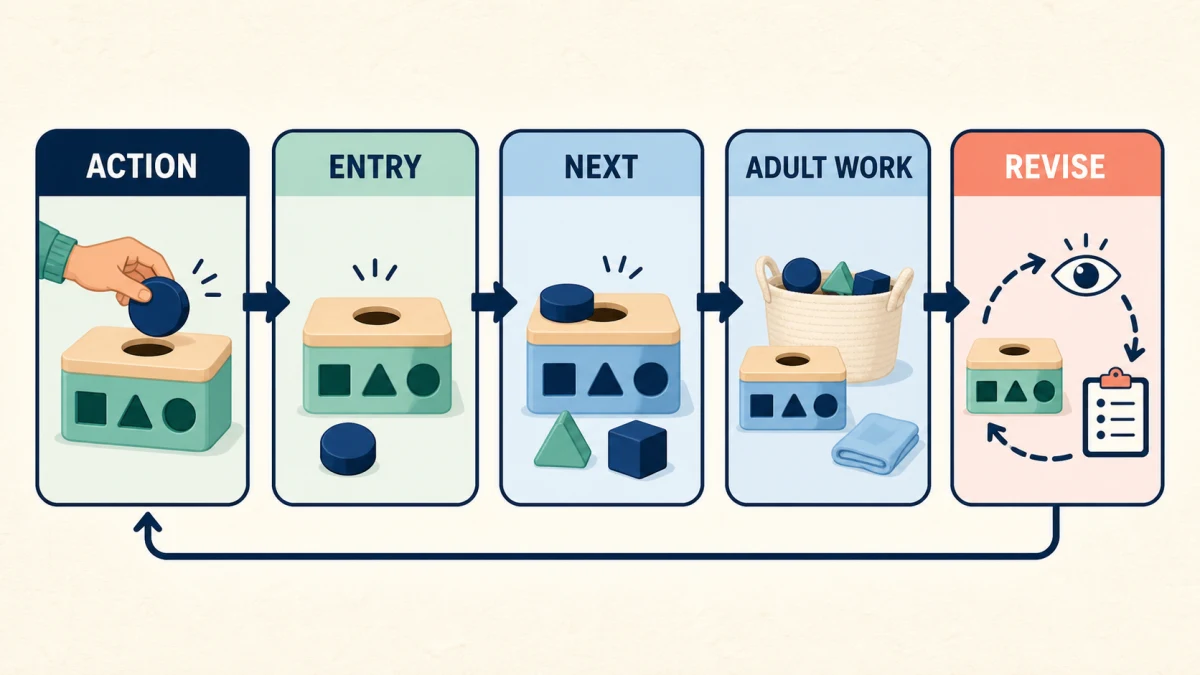
Use the Action–Challenge–Reset Framework
1. Name the action
Replace benefit language with a verb: post, nest, screw, pour, roll, connect, dress, sort, draw, or act out. If the main action is hard to explain, the feature list may be doing more work than the play idea.
2. Find the easiest successful entry
Ask what the child can do before learning any rules. Can they grip the part, make something happen, and repeat it? A toy can have later complexity, but it needs a usable first move. If the only entry requires several instructions or fine alignment, it may be better saved for later.
3. Identify one next challenge
Useful growth does not require more lights or a larger accessory set. The next challenge could be stacking one piece higher, matching by a second attribute, combining two pretend actions, building a path, or taking a turn. One expandable idea is enough.
4. Count adult work
Include unpacking, assembly, instruction, reset, cleanup, charging, and finding lost parts. Adult participation can enrich play, but a toy is a poor fit for independent repetition if an adult must rebuild it after every attempt.
5. Watch the child, then revise
Interest, frustration, mouthing, throwing, and movement change quickly. Put the toy away if the current use creates a hazard or persistent frustration. Reintroducing later is more useful than pushing a child to use it “correctly.”
Compare Toy Types by the Decision They Solve
| Toy type | Useful entry action | Possible next challenge | Often fits when | May not fit when | Verify before use |
|---|---|---|---|---|---|
| Posting or nesting | Drop, place, remove | Sort, sequence, predict | The child enjoys containers and repetition | Pieces are frustrating to align or easy to mouth | Piece size, lid/hinge pinch points, stability |
| Large building pieces | Stack, connect, knock down | Bridge, enclosure, pretend setting | Open-ended construction holds attention | Connectors need too much force | Minimum part size, broken edges, material and cleaning instructions |
| Simple pretend props | Copy one familiar action | Link two or three actions into a sequence | The child imitates meals, care, transport, or chores | The set depends on many tiny accessories | Detachable pieces, cords, sharp points, battery access |
| Chunky puzzles or matching | Lift, turn, place | Match by shape, picture, or relationship | The child enjoys repeating a defined problem | Every attempt needs adult correction | Peg/knob attachment, splinters or chipped finish, piece size |
| Balls and push toys | Roll, kick, push, retrieve | Aim, alternate turns, change speed | The child seeks whole-body movement | The space lacks a safe run-out area | Stability, wheels/axles, cords, intended surface and supervision |
| Art and mark-making | Make a line, dot, or smear | Choose colors, imitate a shape, tell a story | Mess and cleanup are manageable | Materials are not age-graded or the child still mouths them | Age label, ingredient/material information, caps and small accessories |
The current Find Best Toys educational-toy Hub is the broad category owner. Use its categories to browse ideas, then narrow by the child’s action and the room where the toy will be used. The 2-year-old collection provides the upward age context without turning this guide into a product ranking.
Safety Is Part of the Learning Fit
The U.S. Consumer Product Safety Commission explains that toys designed primarily for children 12 and under are subject to applicable toy rules, testing, and manufacturer/importer certification requirements. That does not let an editor declare an unseen product “safe.” The applicable requirements vary by a toy’s materials, mechanisms, batteries, cords, projectiles, and other features. See the CPSC toy-safety overview for the regulatory boundary.
For children under three, small parts require special attention. CPSC’s small-parts guidance explains that a product intended for a child under three cannot contain or release prohibited small parts under the applicable rule. A home-made tube test, an age label, or a marketplace badge is not a substitute for manufacturer compliance and appropriate testing.
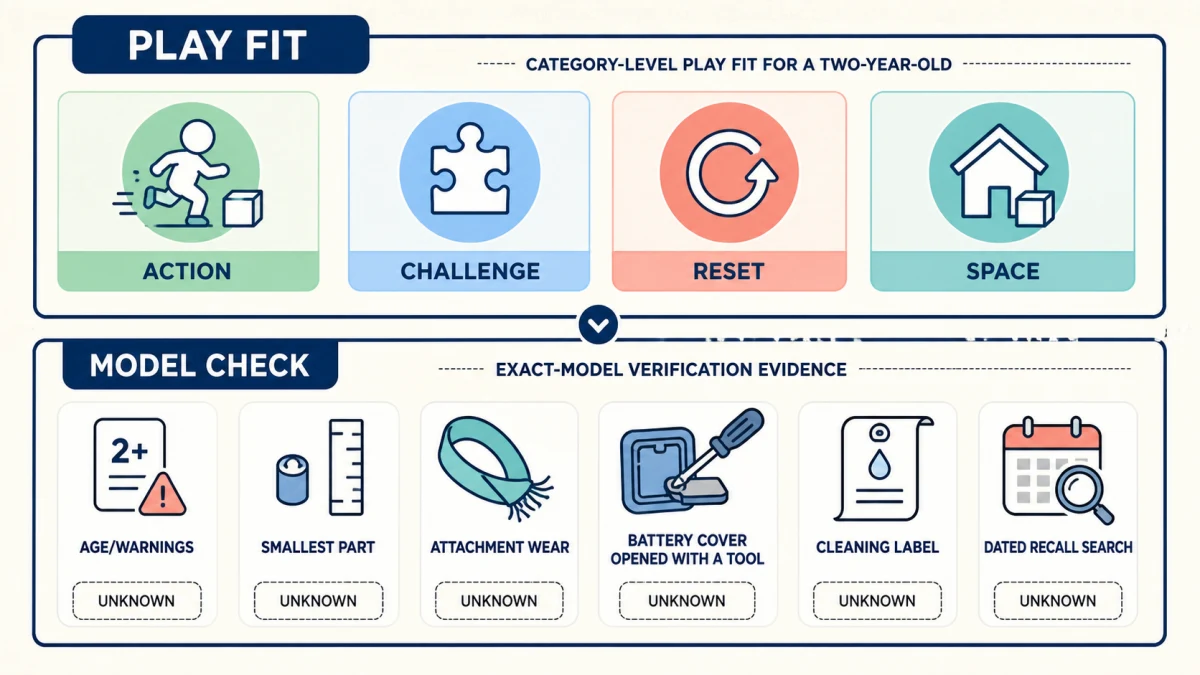
Before first use and during regular play, check:
- the exact age grade and every warning on the product and packaging;
- whether a piece, cap, wheel, eye, peg, fastener, or decoration is loosening;
- accessible battery compartments and the tool needed to open them;
- cracks, splinters, sharp burrs, exposed mechanisms, stretched cords, or unstable bases;
- the manufacturer’s cleaning method and whether cleaning has changed the material;
- the exact product name and model in the live CPSC recalls and warnings search.
A recall search is time-sensitive. CPSC says its recall data updates weekly and remedy information can change more often, so check again immediately before publication and before recommending a named model.
Situations Where This Framework Is and Is Not Enough
A good fit
Use this framework when choosing among category types, reducing a long feature list, planning a small rotation, or deciding why an existing toy is not being used. It works best when you can observe the child and verify the exact product information.
Not enough on its own
This guide cannot determine whether a child is meeting developmental expectations, diagnose a delay, or prescribe a toy as therapy. If a child has lost skills or you have concerns, CDC advises discussing them with the child’s doctor and asking about developmental screening. A pediatrician, early-childhood professional, or relevant therapist can help adapt activities to the child.
It also cannot verify an individual product’s composition, certification, durability, or recall status. Those are model-level facts, not category assumptions.
A Five-Minute Store or Screen Check
- [ ] I can name the toy’s main action in one short sentence.
- [ ] The child has a realistic first move and one possible next challenge.
- [ ] The pieces, effort, noise, and movement fit the child and space now.
- [ ] The age grade and warnings are visible for the exact model.
- [ ] I know what is included and can check dimensions, not just a staged photo.
- [ ] I can inspect batteries, cords, wheels, seams, attachments, and finish as applicable.
- [ ] I can follow the stated cleaning and storage method.
- [ ] I checked the exact product name/model for current CPSC recalls or warnings.
- [ ] I am not relying on “STEM,” “Montessori,” or “learning” as proof of value.
Frequently Asked Questions
Do educational toys for two-year-olds need letters and numbers?
No. Construction, pretend play, matching, movement, drawing, and cause-and-effect can all invite useful observation, language, coordination, and problem solving. Choose the play action before the school-like label.
Is a toy marked age two automatically right for my child?
No. Follow the age grade and warnings as safety information, then consider the child’s current grip, mouthing, movement, interests, and tolerance for challenge. Never move to an older age grade simply to make the toy more “advanced.”
Are electronic learning toys better than simple toys?
Not automatically. Compare the child’s action, feedback, variation, volume, battery access, and adult interaction. Electronic features are useful only when they serve the play rather than replace it.
How many educational toys should be available at once?
There is no evidence-based universal number in the sources used here. Offer a manageable selection the child can see and reset, then adjust based on use, space, and cleanup. Do not present a fixed shelf count as a developmental rule.
What should I do when a toy is too hard?
Simplify the entry, demonstrate once, remove extra pieces, or put the toy away and retry later. Persistent frustration is information about current fit, not a reason to push practice.
Choose the Next Step
Start with one action the child already enjoys and one practical constraint in your home. Use the Toy Finder to narrow by age, interest, skill, and situation, then read the Find Best Toys safety and source policy before treating any record as a recommendation. The First Words Activity Board research record shows the fields Find Best Toys wants to verify; it is an illustrative desk-research record, not a tested pick.
How This Guide Was Prepared—and Its Limits
Find Best Toys Editorial prepared this guide from the dated official sources listed below. It provides general, category-level decision support, names no ranked or hands-on-tested model, and does not replace product instructions or professional advice. No named specialist reviewer is currently listed. Verify the exact product's age label, warnings, instructions, condition, and current recall status before use. We will update this guide when cited guidance or relevant product evidence changes.
References
- CDC: Milestones by 2 Years
- CPSC: Toy Safety
- CPSC: Small Parts Ban and Choking Hazard Labeling
- CPSC: 2020 Age Determination Guidelines
- CPSC: Recalls and Product Safety Warnings
- American Academy of Pediatrics: How to Buy Safe Toys