


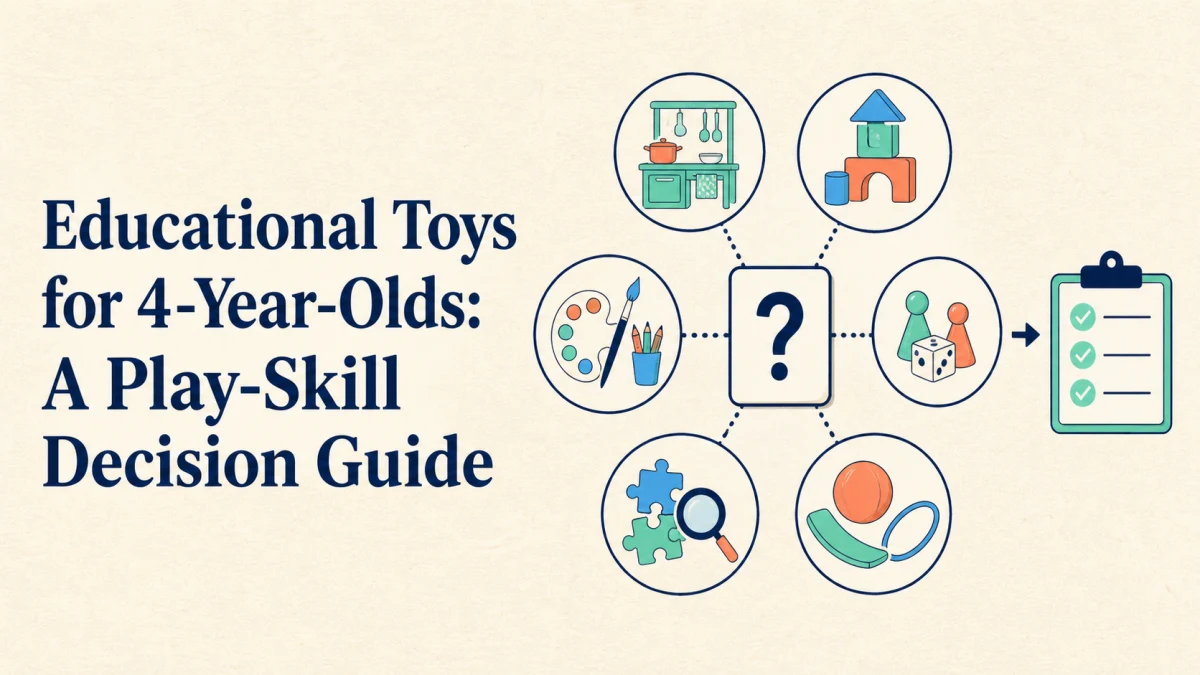
Strong educational toys for 4 year olds create room to tell a story, build and revise, follow a short rule, make something, move with control, or solve a visible problem. The right choice is not whichever box promises the most skills. It is the toy whose first challenge fits the child now and whose later possibilities remain interesting. This is a category-level decision guide, not a ranking: Find Best Toys has not tested or verified individual products for this article.
Key Takeaways
- Start with the kind of play the child chooses: story, construction, making, games, investigation, or movement.
- Look for an easy entry plus a challenge that can grow through new rules or ideas.
- Count adult setup, explanation, conflict management, cleanup, and storage.
- Use developmental sources as observation context, never as a pass/fail shopping test.
- Confirm every named product’s age grade, contents, instructions, warnings, and recall status before publication or use.
What Changes Around Age Four?
The CDC’s age-four milestone page offers examples of what many children may do by this age: pretend to be someone else in play, tell what comes next in a familiar story, name some colors, catch a large ball, unbutton some buttons, and use a more mature crayon grip. These examples can help an adult notice possible entry points for play. They do not prove that a toy will cause a skill, and CDC states that milestone materials do not replace validated screening.
Instead of asking, “Which toy teaches the most?” ask:
- What does this child already choose without prompting?
- Would a clearer tool, richer material, new role, or simple rule extend that play?
- Can the child change the result rather than only trigger a scripted response?
- Is the challenge understandable before an adult gives a lesson?
Educational value often comes from the relationship between child, material, other people, and setting. The toy is one part of that system.
Choose a Play Family Before a Product
| Play family | What the child can do | What makes it richer | Good fit when | Poor fit when | Product facts to verify |
|---|---|---|---|---|---|
| Pretend and small-world play | Assign roles, make a scene, act out a sequence | Open props, multiple characters, room to change the story | The child narrates or imitates familiar situations | The set dictates one branded story or relies on many fragile parts | Piece dimensions, detachable accessories, paint/finish, cleaning |
| Construction | Connect, balance, enclose, bridge, rebuild | Different shapes, stable connections, compatibility within the set | The child enjoys trial, collapse, and repair | Connections are painfully tight or instructions are the only goal | Part size, connector force, magnets if present, broken-edge risk |
| Art and making | Draw, cut, press, collage, model | Choice of material, reversible experimentation, display or reuse | Process matters more than copying a perfect sample | Materials or tools are not age-graded; cleanup makes use unlikely | Materials, ventilation/skin instructions, caps, scissors, storage |
| Simple games | Match, remember, wait, follow one rule | Short rounds, visible feedback, adjustable difficulty | The child likes turns and can recover from losing with support | Rules require long explanations or elimination creates distress | Small pieces, timer/battery access, complete instructions |
| Puzzles and investigation | Observe, compare, rotate, test, classify | More than one strategy, self-visible progress, a next question | The child returns to defined problems | One mistake stops the whole activity | Piece fit, sharp edges, model accuracy, replacement parts |
| Movement play | Throw, catch, aim, balance, imitate | Clear space, adjustable distance, cooperative variations | Active play fits the child and environment | The product needs more clearance or protective setup than available | Intended surface, protective equipment, stability, projectile rules |
Browse the current educational-toy Hub for the broad category, but use the table to decide which family deserves attention. The 3–5-year age collection remains the product-discovery owner for the wider preschool band.
Apply the Entry–Variation–Recovery Test
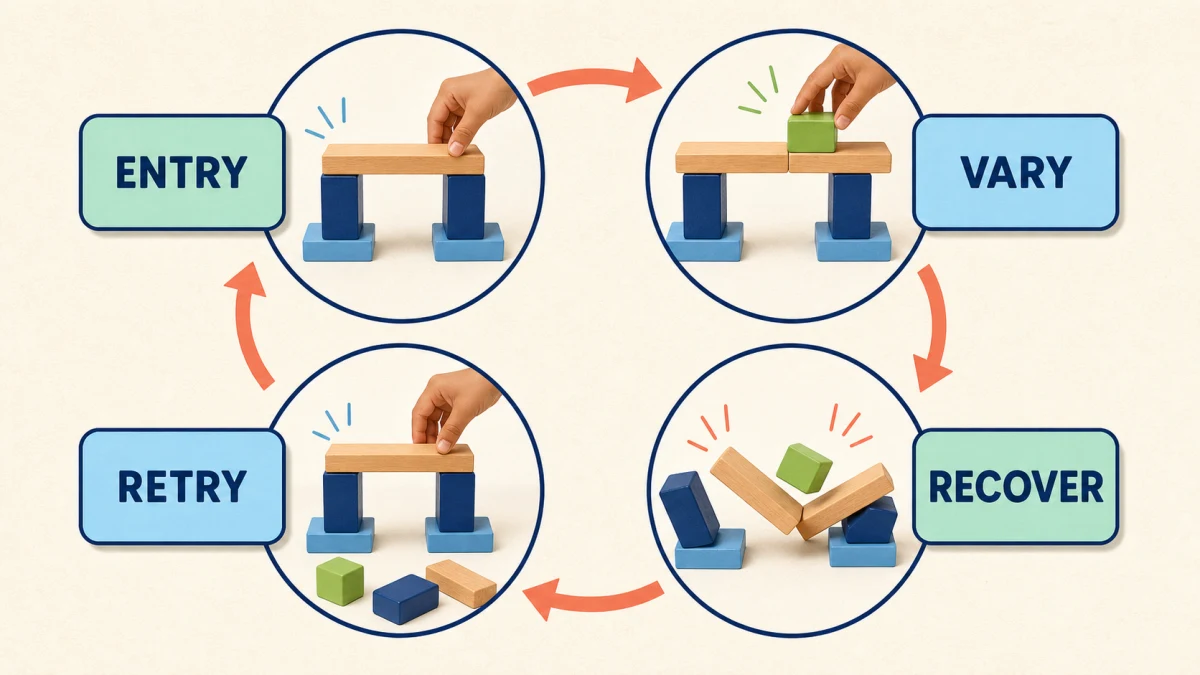
Entry: Can play begin quickly?
The child should be able to make a meaningful first move with limited explanation. That might be connecting two pieces, choosing a role, placing a card, drawing a line, or rolling a ball. A difficult first step can hide later possibilities.
Variation: Can the child change the idea?
Variation is a better growth signal than a long feature list. Can the structure become a bridge, animal home, or ramp? Can the game use fewer cards today and more later? Can pretend props support a shop one day and a journey the next? Avoid declaring a toy open-ended when every outcome depends on buying another accessory.
Recovery: What happens after failure?
A useful challenge makes retrying possible. Pieces stay within reach, the structure can be repaired, a round ends soon, or the result shows what changed. A toy that locks up, scatters dozens of pieces, or demands an adult reset after every error may teach dependence on the adult more than independent problem solving.
Measure the Hidden Costs
Price is not the only cost, and this guide does not have current price data. Compare:
- floor or table area during play, including reach and movement space;
- adult assembly and the tools required;
- how many loose pieces must be counted and stored;
- consumables or replacement parts;
- sound level and whether it can be controlled;
- charging, apps, accounts, or connectivity, if any;
- cleaning method and drying time;
- whether siblings of different ages can access unsuitable pieces.
The Wooden Building Block Set research record illustrates fields such as piece size, finish, stability, and play range. It is not a tested recommendation; its unknowns show why a category cannot stand in for a model dossier.
Safety and Limitation Check
The CPSC toy-safety guidance explains that different rules and test provisions apply to different toy features, including small objects, points, edges, cords, wheels, projectiles, batteries, magnets, and other mechanisms. A certification or marketplace claim must be verified for the exact product; an editor cannot infer compliance from a category or photograph.
For a four-year-old, do not assume that “not for under three” is the only question. Consider younger siblings and visitors, whether pieces loosen with wear, whether a projectile accepts improvised objects, whether a costume cord can snag, and whether an electronic compartment stays secured. Follow the manufacturer’s intended use, age grade, assembly, protective-equipment, and supervision instructions.
Use the live CPSC recalls and warnings database with the exact brand, product name, and model. Search again shortly before publication because the dataset and remedies change.
This guide cannot diagnose a developmental need, guarantee readiness, or promise that a toy builds creativity, attention, language, executive function, or school performance. If you have a concern about development, discuss observations with the child’s doctor or teacher rather than buying a toy as treatment.
A Practical Shortlisting Scorecard
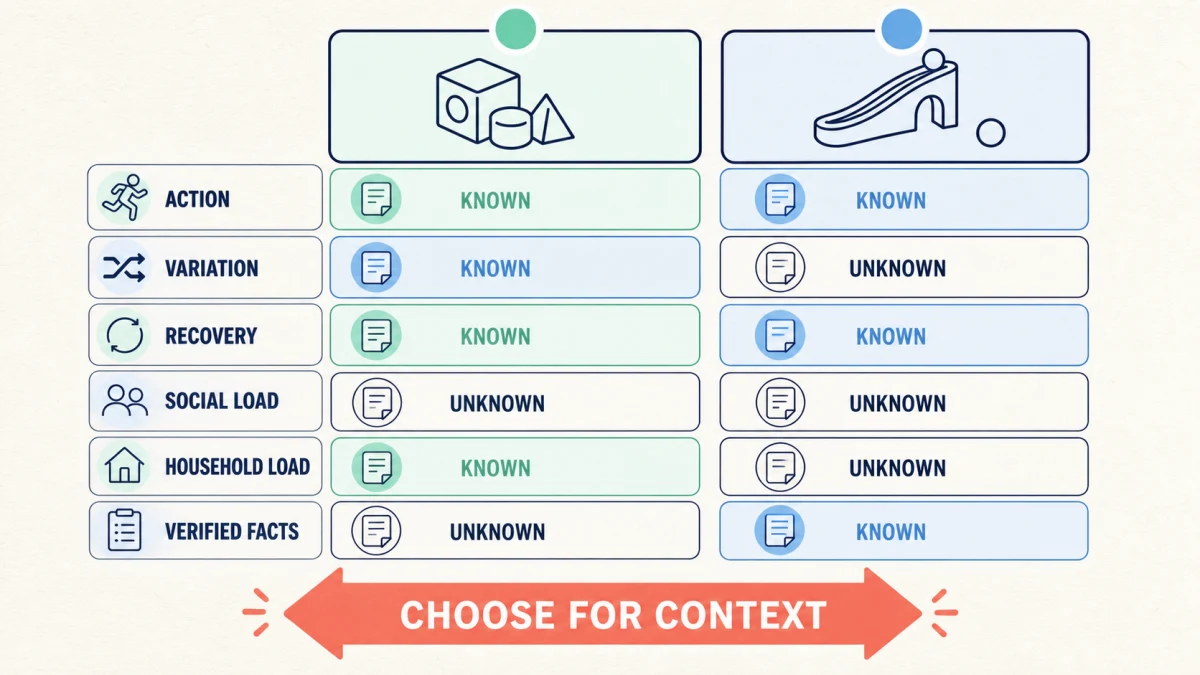
Score each candidate with notes, not stars:
| Question | Evidence to record | Reject or pause when |
|---|---|---|
| What is the first playable action? | One plain-language sentence | The action is hidden behind setup or a tutorial |
| What can change on the next play? | Two realistic variations | Variation requires a separate purchase or app |
| How does the child recover? | Reset or repair path | An adult must fix every mistake |
| What social load exists? | Solo, parallel, cooperative, or competitive use | The required turn-taking exceeds the current setting |
| What household load exists? | Space, noise, pieces, cleanup, charging | The toy will stay stored because use is impractical |
| What safety facts are verified? | Label, warnings, instructions, dimensions, current recall search | Model identity or critical warnings are unavailable |
Do not total the rows into a universal score. A quiet art tool and an outdoor ball solve different needs. The scorecard exposes trade-offs so the adult can choose deliberately.
When Different Choices Make Sense
Choose pretend materials when…
The child already builds stories, copies routines, or enjoys taking roles. Fewer flexible props may outlast a detailed set with one prescribed story.
Choose construction when…
The child enjoys making, testing balance, or rebuilding after collapse. Check connector force and piece scale rather than assuming more pieces mean more value.
Choose a simple game when…
The child wants shared rules and short turns. Begin with a short round and cooperative variation if competition overwhelms the play.
Choose art or making when…
The process—marking, mixing, arranging, cutting, or modeling—holds attention. Verify every material and tool for age and use, and plan the cleanup before buying a large kit.
Wait when…
The product is labeled for an older age, critical dimensions or instructions are missing, the play needs constant adult correction, or the child shows no interest in the underlying action. “Growing into it” is not a reason to ignore a safety label.
Frequently Asked Questions
What are the most educational toy types for a four-year-old?
There is no universal winner. Pretend props, building systems, age-appropriate art materials, simple games, puzzles, and movement equipment can all support rich play when the action, challenge, and setting fit the child.
Should a four-year-old’s toy prepare them for school?
It can invite stories, conversation, counting in context, patterning, making, turn-taking, and problem solving without imitating worksheets. School readiness is broader than recognizing symbols, and no toy guarantees it.
Are “STEM” toys automatically educational?
No. Ask what the child builds, tests, predicts, measures, or revises. “STEM” is a marketing category unless the play action and evidence are clear.
Is a difficult toy better because it lasts longer?
Not if the child cannot enter the play. Look for a simple starting move and a real progression. Difficulty that only produces adult rescue is not useful longevity.
How do I compare two toys with different play styles?
Do not force them into one score. Compare which current need each solves, its household load, the child’s interest, the safety facts available, and whether the play can vary over time.
Make the Next Decision
Write down the child’s current play preference and one constraint—space, noise, cleanup, group size, or portability. Use the Toy Finder to narrow the category, then consult Find Best Toys’ review process to see which product fields must be verified before a record can become a recommendation.
How This Guide Was Prepared—and Its Limits
Find Best Toys Editorial prepared this guide from the dated official sources listed below. It provides general, category-level decision support, names no ranked or hands-on-tested model, and does not replace product instructions or professional advice. No named specialist reviewer is currently listed. Verify the exact product's age label, warnings, instructions, condition, and current recall status before use. We will update this guide when cited guidance or relevant product evidence changes.
References
- CDC: Milestones by 4 Years
- CPSC: Toy Safety
- CPSC: 2020 Age Determination Guidelines
- CPSC: Recalls and Product Safety Warnings
- American Academy of Pediatrics: How to Buy Safe Toys