


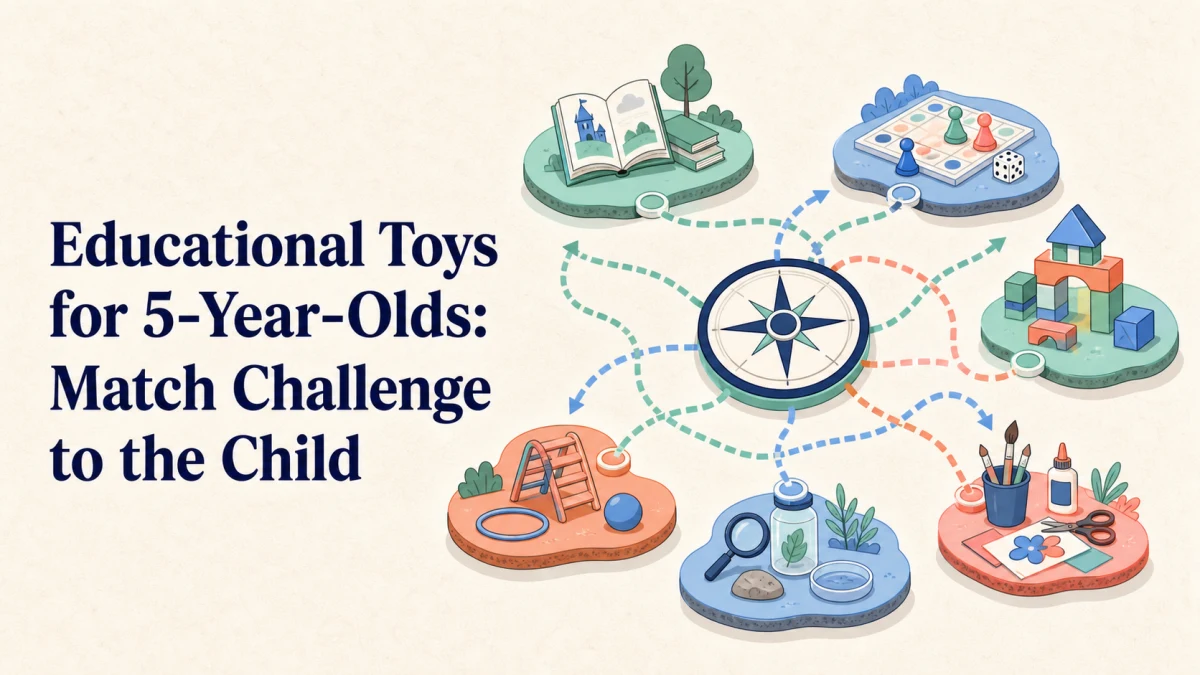
Useful educational toys for 5 year olds let a child make decisions: invent a story, follow and modify a rule, plan a structure, investigate a question, create an object, or coordinate movement. Choose the challenge the child is ready to enter, not the product with the most school-like claims. The strongest option may be a simple material that supports many ideas. This guide compares decision criteria and toy types; it does not rank products or imply hands-on testing.
Key Takeaways
- Choose a mode of thinking and playing, not a promise to make a child “school ready.”
- Look for a clear first challenge, several ways to vary it, and a fair path to retry.
- Treat rules, literacy, numbers, making, stories, and movement as connected parts of play.
- Count social fit, adult instruction, setup, piece management, storage, and noise.
- Verify exact-model age information, warnings, instructions, contents, and current recalls before use or publication.
Use Developmental Context Carefully
The CDC’s age-five milestone guidance gives examples such as taking turns in games, telling a story with at least two events, counting, recognizing some letters and numbers, attending to a non-screen activity for several minutes, and fastening some buttons. The same page emphasizes that milestone materials are not a substitute for validated developmental screening.
These examples are useful for observing play possibilities, not for building a shopping test. A child does not need a counting toy because counting appears on a milestone page. A story set, board game, construction problem, craft, outdoor challenge, or real household task may integrate several skills without announcing them on the box.
Avoid three common shortcuts:
- “Teaches kindergarten.” Ask which action, conversation, or problem is actually available.
- “Ages 5+ means ideal at five.” The age grade is essential, but it does not describe the individual child’s interests or the full challenge curve.
- “More content means more learning.” A large library of facts can still leave the child pressing buttons rather than forming ideas.
Start with the Child’s Preferred Kind of Challenge
| Challenge | Observable play | Useful progression | Often suitable when | Less suitable when | Verify |
|---|---|---|---|---|---|
| Story and role | Create characters, events, places, problems | Longer sequences, alternative endings, shared roles | The child narrates and negotiates ideas | Branded scripts restrict invention or accessories dominate | Parts, costumes/cords, finish, cleaning, storage |
| Rules and strategy | Remember a short rule, take turns, make a choice | Add a rule, compare strategies, keep simple records | Shared play and short rounds appeal | Long waits, elimination, or reading load blocks entry | Piece size, complete rules, timer/battery safety |
| Construction and design | Plan, build, test, revise | Add constraints, measure, document, collaborate | The child tolerates collapse and enjoys repair | Connector force or instructions create adult dependence | Dimensions, magnets, edges, compatibility claims |
| Making and art | Choose tools and materials, plan steps, revise | Combine media, make for a purpose, explain choices | The process matters more than a perfect result | The kit requires copying or unsuitable tools/materials | Age grading, material instructions, ventilation, cleanup |
| Investigation | Observe, sort, compare, predict, record | Ask a new question or vary one condition | The child likes facts and “what if” questions | The result is predetermined or marketed as magic | Accuracy, contents, protective setup, consumables |
| Movement and coordination | Aim, balance, follow a movement rule, create a course | Change distance, sequence, or team goal | Space and supervision support active play | Clearance, surface, or protective needs are unmet | Intended surface, stability, projectiles, protective gear |
Use the Find Best Toys educational-toy Hub to browse the broad category. The 3–5-year collection owns the wider age-band discovery intent; this article owns the exact age-five decision.
Apply the Five-Layer Fit Test
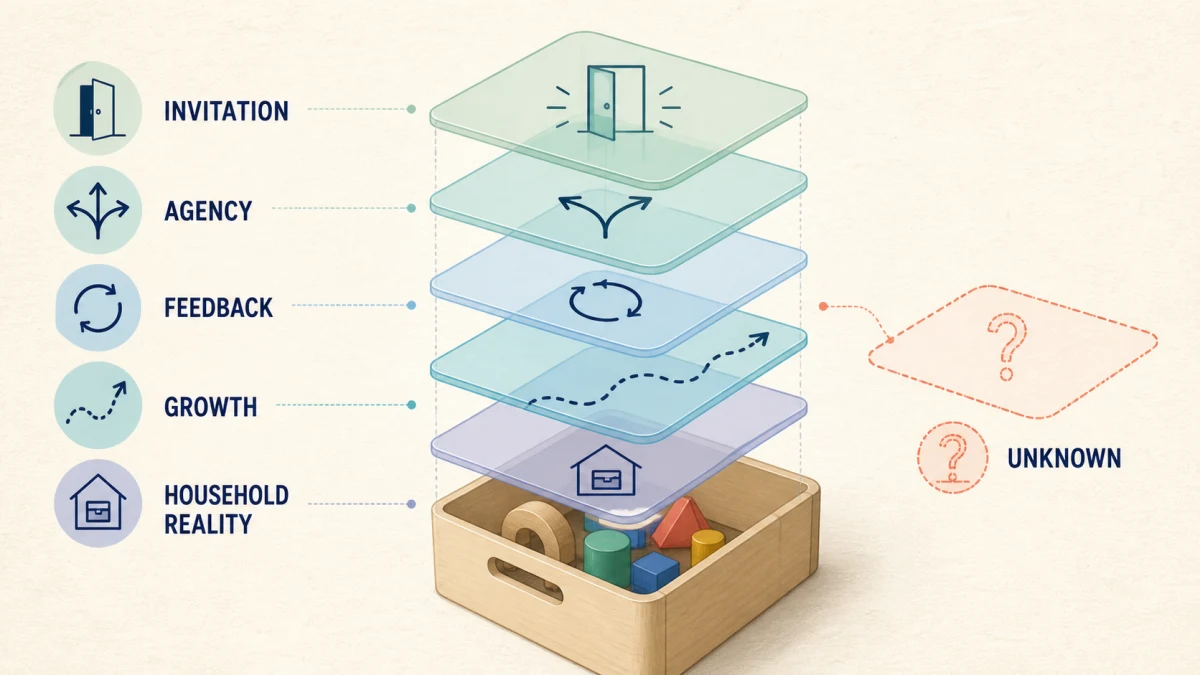
Layer 1: Invitation
Can the child see what they might do without watching a long demonstration? A puzzle has pieces and a target; construction has materials and connections; pretend play has recognizable roles or props. A toy that looks inactive until an adult configures an app has a high entry cost.
Layer 2: Agency
The child should make choices that change the result. Choosing only which button starts the same animation is limited agency. Deciding where a bridge goes, which rule to try, how a character solves a problem, or which material creates a texture produces a meaningful difference.
Layer 3: Feedback
Good feedback can be physical, visual, social, or conceptual: a structure stands, a piece aligns, a partner responds, a pattern continues, or an experiment changes. Feedback need not be an electronic score. It should help the child decide what to do next.
Layer 4: Growth
Write two realistic variations that use the same core set. If growth depends entirely on buying expansion packs, subscribing to content, or following harder worksheets, the product may have narrower play value than advertised.
Layer 5: Household reality
Record floor space, play duration, adult availability, group size, noise, number of pieces, cleanup, and storage. A good educational idea that cannot be used in the home or classroom is not a good practical fit.
Avoid “Schoolwork in a Box”
School-like content is not automatically bad, but it should not crowd out play. Before buying a product centered on letters, numbers, or facts, ask:
- Does the child manipulate, compare, explain, or create—or only select an answer?
- Can the material be used in more than one sequence?
- Does an error open another attempt, or does it produce a negative sound and stop?
- Can an adult join a conversation rather than manage an interface?
- Would ordinary books, drawing tools, counters, cards, blocks, or pretend props serve the same goal more flexibly?
The point is not to ban explicit learning materials. It is to compare the quality of the interaction with the strength of the marketing promise.
Safety, Privacy, and Evidence Limits
The CPSC toy-safety page explains that toy requirements depend on the product’s actual features. Applicable provisions can cover small objects, points, edges, cords, projectiles, batteries, magnets, folding mechanisms, wheels, and other hazards. Do not infer compliance from a marketplace listing, a “STEM” label, or a photograph.
For connected or app-supported products, this guide has not verified privacy, account, software-support, or network-security claims. Those need a separate current product review. If a toy requires a phone to deliver its core play, include device access, updates, advertising, account ownership, and what happens when the service stops in the decision.
Check the exact model in the live CPSC recall and warning database. CPSC notes that its recall data updates weekly and remedy details can change, so an old search result is not a publication-ready check.
This guide does not assess learning disabilities, attention, readiness for school, or need for services. Do not promise that a toy improves intelligence, reading, math, attention, executive function, or classroom behavior. Bring concerns about development or learning to the child’s teacher and health-care professional.
Build a Two-Toy Shortlist
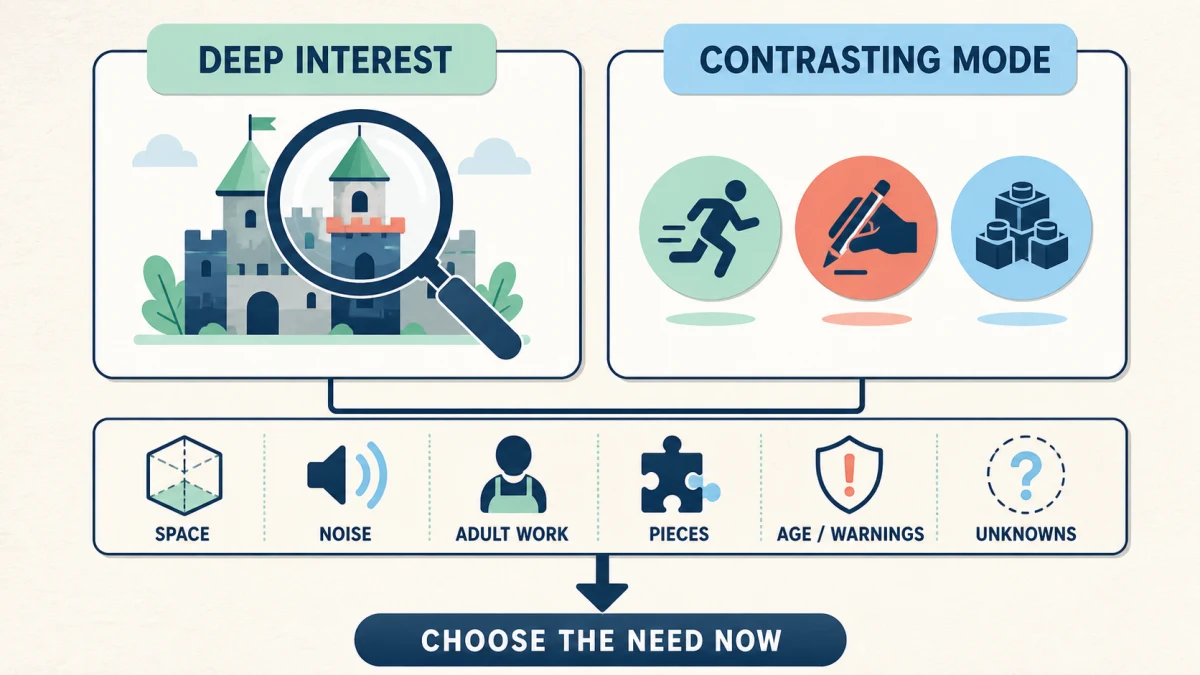
Instead of collecting ten similar “learning” products, compare two candidates that solve different needs.
- Write one current play pattern: “builds vehicles,” “draws characters,” “likes short games,” or “asks how machines work.”
- Choose one extension of that pattern, not a replacement.
- Choose one contrasting mode—movement if most play is seated, a story material if most play is rule-based, or a cooperative game if most play is solitary.
- Apply the five-layer test to both.
- Reject any model with missing identity, warnings, instructions, contents, or critical dimensions.
- Borrow or observe a similar category when possible before buying another large system.
The Wooden Building Block Set research record shows how Find Best Toys records material, piece-size, stability, and play-range unknowns. It is an illustrative record, not a tested recommendation.
What Fits—and What Does Not
This framework fits when…
You are choosing a birthday gift, refreshing a classroom or home play area, comparing a game with a building set, or deciding whether “educational” claims describe real actions.
Choose a different path when…
The child needs an accessibility adaptation, has a therapy goal, or finds the typical rules/materials inaccessible. Consult the relevant professional and the child; do not use a generic age guide as a prescription.
Wait when…
The age grade is older, a projectile or chemistry activity lacks required protective setup, an app is necessary but its current terms are unknown, or the product’s exact identity cannot be confirmed.
Frequently Asked Questions
What educational toys are useful before kindergarten?
Useful categories include open construction, pretend play, simple games, age-appropriate art and making, puzzles, investigation materials, books, and movement equipment. The fit comes from what the child does, not the category name alone.
Should a five-year-old use toys with reading or math content?
They can if the child enjoys the action and can enter it without pressure. Compare a scripted quiz with playful alternatives such as storytelling, counting during a game, measuring a construction, or looking for patterns.
Are board games educational for five-year-olds?
They can invite rule-following, turn-taking, memory, choice, and conversation. Choose short, understandable rounds and verify small pieces, reading load, and whether competition suits the current group.
Is a product with many difficulty levels better value?
Only if the first level is usable and later levels change the thinking rather than merely adding more questions. Verify whether the levels are included, app-dependent, or sold separately.
How can I tell if a toy is too easy?
Watch whether the child can still invent a new rule, structure, story, or goal. Mastery is not automatically a reason to remove an open material. A single-purpose product with no remaining decision may have reached its limit.
Choose the Next Step
Use the Toy Finder with one preferred play mode and one household constraint. For a gift, the Gift Finder can organize age and situation, but every result still needs model-level verification. Read Find Best Toys’ safety and source policy before treating a desk-research record as a recommendation.
How This Guide Was Prepared—and Its Limits
Find Best Toys Editorial prepared this guide from the dated official sources listed below. It provides general, category-level decision support, names no ranked or hands-on-tested model, and does not replace product instructions or professional advice. No named specialist reviewer is currently listed. Verify the exact product's age label, warnings, instructions, condition, and current recall status before use. We will update this guide when cited guidance or relevant product evidence changes.
References
- CDC: Milestones by 5 Years
- CPSC: Toy Safety
- CPSC: 2020 Age Determination Guidelines
- CPSC: Recalls and Product Safety Warnings
- American Academy of Pediatrics: How to Buy Safe Toys