


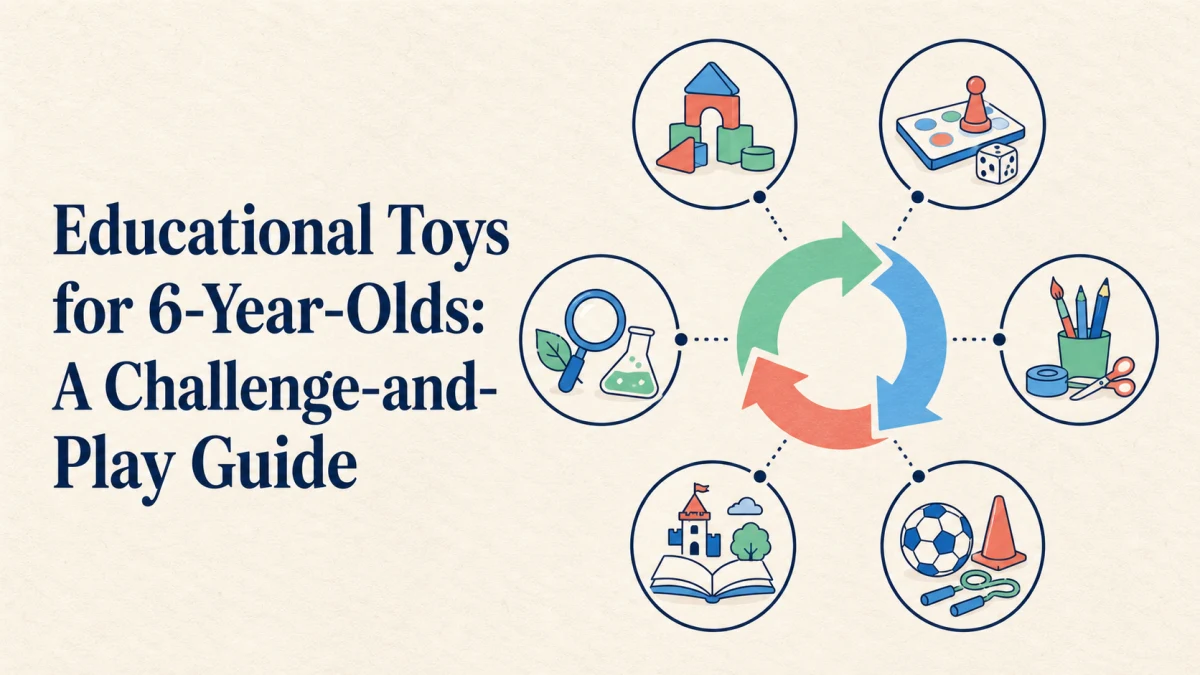
Good educational toys for 6 year olds give the child a real problem or idea to own: build under a constraint, plan several moves, make and revise an object, investigate a system, tell a connected story, or cooperate toward a goal. Choose depth and replay value over a long list of lessons. A six-year-old may also want humor, mastery, collecting, movement, or social play; “educational” should not erase those motives. This guide evaluates categories, not products, and makes no hands-on ranking.
Key Takeaways
- Look for agency, feedback, revision, and several valid outcomes.
- Match reading, fine-motor, rule, and frustration demands to the individual child.
- Prefer challenge that changes strategy, not just a longer worksheet or faster timer.
- Include social fit, setup, durability, storage, consumables, and device dependence.
- Verify the exact product’s age grade, model, contents, warnings, instructions, and recall status.
Six Is an Age, Not a Single Skill Level
Age-specific search terms are useful for navigation, but they can tempt editors to write a fictional “typical six-year-old.” Children vary in reading experience, motor control, play preferences, familiarity with rules, tolerance for uncertainty, and need for accessibility support. The CPSC’s 2020 Age Determination Guidelines relate age determinations to product characteristics, skills, interests, and play behavior; they do not turn a birthday into a universal ability profile.
Begin with four observations:
- What kinds of problems does the child choose without a reward?
- What currently causes productive persistence, and what causes shutdown?
- Does the child prefer solo, side-by-side, cooperative, or competitive play?
- Which practical constraints—space, noise, time, reading load, hand strength, cleanup—shape use?
The answer should change the shortlist more than an “educational” badge.
Compare Challenge Types
| Challenge type | Core decisions | How it can deepen | Strong fit when | Weak fit when | Facts to verify |
|---|---|---|---|---|---|
| Construction and engineering | Choose materials, connection, shape, sequence | Add load, span, scale, motion, budget, or collaboration constraints | The child enjoys physical testing and rebuilding | Instructions become the only valid outcome | Dimensions, connector force, magnets, edges, compatibility |
| Strategy and games | Read a state, choose a move, anticipate others | Add new roles, variable setups, or cooperative goals | Rules and short feedback loops appeal | Reading or waiting blocks the intended decisions | Age grade, small pieces, exact rules, timer/battery access |
| Making and tools | Plan, measure, assemble, decorate, revise | Use new materials or design for another person | The child wants a usable or expressive result | Adult completion replaces child agency | Tool/material age grade, protective instructions, consumables |
| Investigation | Observe, predict, compare, classify, record | Change one condition and ask a new question | The child asks how or why and accepts uncertain results | The kit reveals one scripted “wow” and ends | Contents, accuracy, chemicals, heat/electricity, eye/skin protection |
| Narrative systems | Build characters, settings, problems, causality | Multiple viewpoints, longer arcs, group negotiation | Stories, worlds, history, or role-play motivate | A licensed script leaves little room to change events | Pieces, projectiles, costume cords, IP/model identity |
| Active challenges | Coordinate, aim, sequence, cooperate, set a course | Change distance, timing, route, team roles | Movement supports engagement and space is appropriate | Required surface, clearance, or protective setup is absent | Stability, projectiles, intended surface, protective gear |
The educational-toy Hub owns the broad query, while the 6–8-year age collection owns product discovery across the band. This page owns the exact six-year-old decision framework.
Use the Agency–Feedback–Revision Test
Agency
List the decisions the child makes. “Select an answer from four choices” is one kind of agency; designing a bridge, choosing materials, negotiating a role, or planning several moves may create more. Neither digital nor physical format guarantees agency.
Feedback
Identify what helps the child evaluate an idea. Physical feedback can be balance or fit. Strategic feedback can be a changed game state. Social feedback can be another player’s response. Informational feedback can be a measurement or observation. An electronic celebration is not evidence that the child understands why something worked.
Revision
Ask what a second attempt looks like. Does the child change a plan, material, rule, sequence, or explanation? If replay means receiving a new batch of the same questions, the product may provide practice but limited design depth. Describe that honestly.
Distinguish Support from Takeover
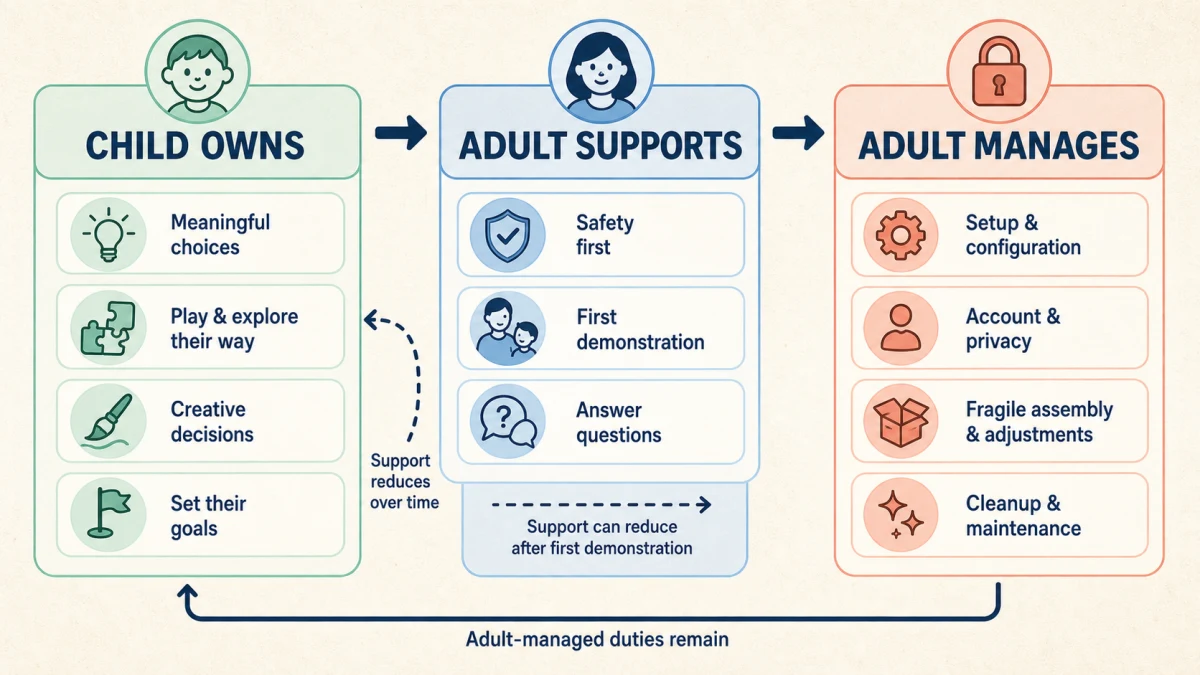
Adult support may include reading a rule, demonstrating tool safety, asking a clarifying question, or helping a group negotiate. Adult takeover occurs when the adult assembles the difficult parts, gives every answer, manages an app, repairs every failure, or finishes the project for display.
Before buying, separate tasks into three columns:
- Child can own now: meaningful decisions and actions.
- Adult supports initially: safety setup, a short demonstration, difficult reading.
- Adult must always do: charging, account setup, fragile assembly, complex cleanup.
A product can still be worthwhile with adult involvement, but the label should say “shared project,” not “independent learning toy.”
Check the Real Cost of a System
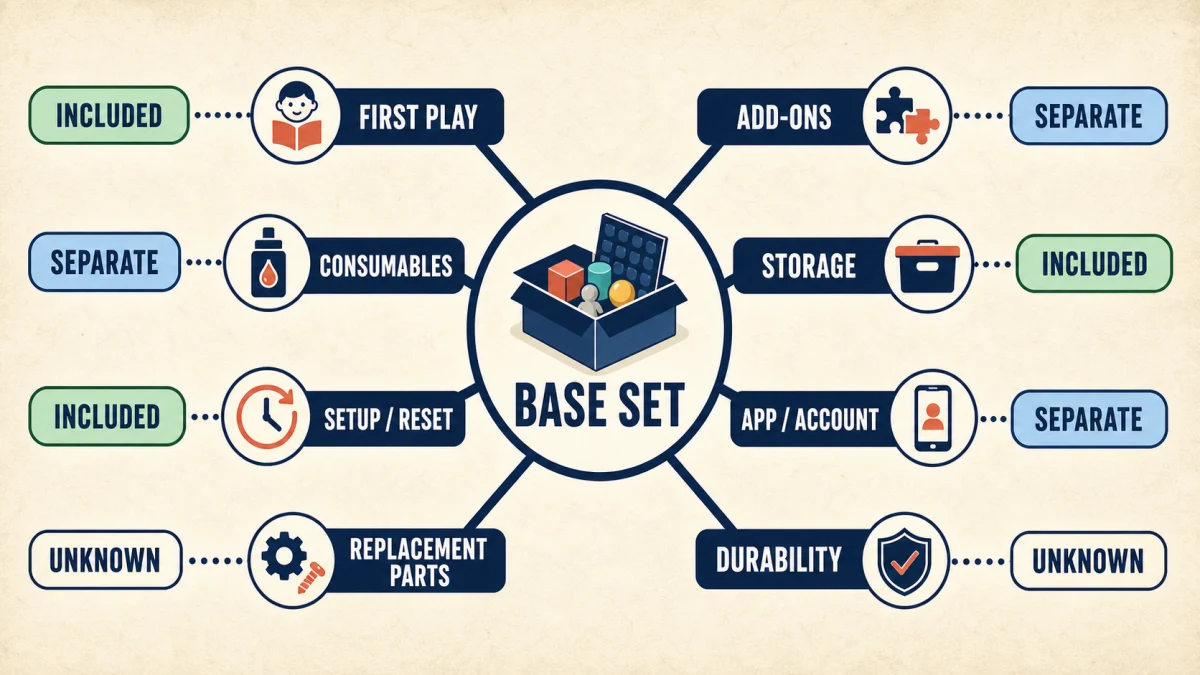
This guide contains no current price data. To judge value, verify what is included and record:
- whether a starter set produces complete play without add-ons;
- compatibility claims and whether they are manufacturer-supported;
- consumables, replacement parts, batteries, subscription, or printing;
- storage volume and a way to find critical pieces;
- setup and reset time for an ordinary session;
- app, device, account, update, and service-shutdown dependence;
- durability of high-load connections, cards, hinges, tools, and containers;
- whether later challenges change the thinking or only add volume.
The Wooden Building Block Set research record illustrates how piece size, finish, stability, and play range can be documented while unknowns remain visible. It is not a product recommendation.
Safety and Evidence Boundary
Under the CPSC toy-safety framework, the applicable requirements depend on the product. For school-age toys, relevant features may include small objects, points, edges, projectiles, cords, electrical or battery components, magnets, chemicals, tools, and protective instructions. “Ages 6+” is not permission to ignore warnings, use a toy outside its intended setting, or expose younger siblings to parts.
Verify:
- exact product and model identity, not only a family name;
- age grade and every warning on product, package, and instructions;
- included tools, materials, projectiles, magnets, batteries, and protective items;
- assembly and adult-supervision requirements;
- current manufacturer instructions and replacement-part policy;
- the exact model in the CPSC recalls and warnings database.
This article does not verify certification, model performance, durability, privacy, curriculum alignment, or learning outcomes. It cannot diagnose a learning need or prescribe a product. If a child needs an accessible controller, modified rules, larger pieces, reduced language load, or sensory adaptation, involve the child and an appropriate educator or clinician.
Shortlist Without a Ranking
Create one candidate for each of three roles:
- Deep interest: extends something the child already explores.
- Different mode: adds movement, making, social play, or narrative to a narrow routine.
- Shared challenge: gives an adult or peer a genuine role without taking control.
For each candidate, write:
- the first decision;
- the feedback;
- one revision;
- one later variation;
- the adult’s role;
- total setup/reset burden;
- unresolved product facts.
Do not total these into “best overall.” Choose the role that matters now. A strategy game and a tool-based construction kit are not interchangeable simply because both are educational.
When This Guide Fits—and When It Does Not
Use it for category selection, gift planning, comparing physical and digital play, or evaluating a system’s promised longevity. Do not use it to determine school placement, measure intelligence, treat attention or anxiety, or replace an individualized education or therapy recommendation.
Pause when the product depends on an unverified app, has unclear included parts, lacks accessible instructions, requires protective equipment you do not have, uses an older age grade, or cannot be identified precisely enough for a recall search.
Frequently Asked Questions
What makes a learning toy suitable for a six-year-old?
A suitable toy has a safe, understandable entry; decisions the child can own; feedback that supports another attempt; and enough variation for current interests. Age and warnings still control the boundary.
Are STEM kits the best educational toys for six-year-olds?
Not automatically. Some provide rich design and investigation; others offer one adult-led demonstration. Evaluate agency, feedback, revision, safety setup, and what remains after the first result.
Should a toy match first-grade curriculum?
Only if curriculum practice is the actual need and a qualified educator considers it appropriate. Rich play can involve language, quantity, evidence, design, cooperation, and creativity without copying school assignments.
Are toys labeled 8+ okay for an advanced six-year-old?
Do not override an older age grade based on an “advanced” label. The grade may reflect safety, required reading, dexterity, tool use, or complexity. Follow the exact manufacturer information and choose a safer current fit.
How do I avoid buying a system that needs endless add-ons?
Verify the included parts, build or play possibilities in the base set, compatibility claims, replacement policy, and whether later challenge requires purchases. Treat unavailable facts as unknown, not a benefit.
Choose the Next Step
Start with the child’s preferred challenge type and one practical constraint. Use the Toy Finder for age, skill, interest, and situation, or the Gift Finder for a gift-stage shortlist. Then apply Find Best Toys’ review process to the exact model before treating it as a recommendation.
How This Guide Was Prepared—and Its Limits
Find Best Toys Editorial prepared this guide from the dated official sources listed below. It provides general, category-level decision support, names no ranked or hands-on-tested model, and does not replace product instructions or professional advice. No named specialist reviewer is currently listed. Verify the exact product's age label, warnings, instructions, condition, and current recall status before use. We will update this guide when cited guidance or relevant product evidence changes.
References
- CPSC: 2020 Age Determination Guidelines
- CPSC: Toy Safety
- CPSC: Recalls and Product Safety Warnings
- American Academy of Pediatrics: How to Buy Safe Toys