


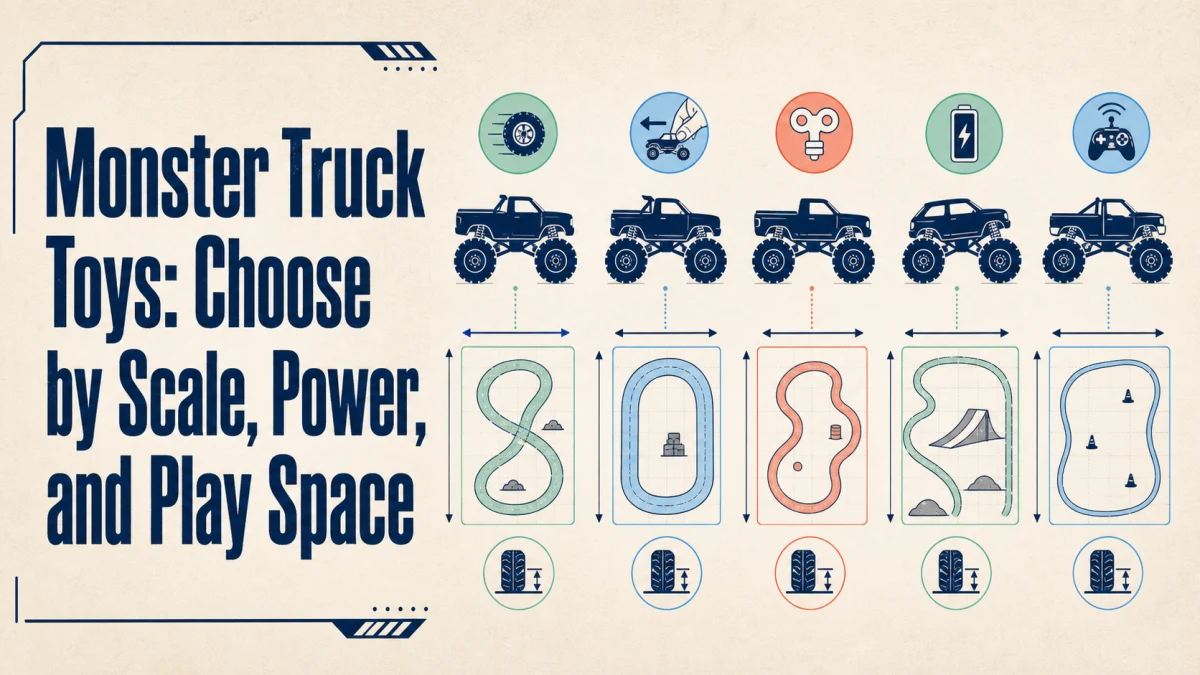
Choose monster truck toys by scale, propulsion, wheel construction, control demands, and the surface and space available—not by the biggest tires or loudest licensed box. A free-rolling truck, pull-back vehicle, mechanical wind-up model, battery-powered truck, and remote-controlled truck create different play. Verify the exact model’s dimensions, age grade, parts, batteries, warnings, instructions, and current recalls. Find Best Toys has not tested any truck for this guide, so it contains no “best overall” or performance ranking.
Key Takeaways
- Decide whether the child wants hand-powered stories, a repeatable mechanism, or steering/control.
- Verify actual dimensions and scale; product photos can hide size and part differences.
- Match tires, clearance, speed, turning space, noise, and retrieval to the intended surface.
- Treat detachable wheels, axles, projectiles, accessible gears, batteries, magnets, and remote parts as model-specific checks.
- Separate generic monster-truck play from licensed characters, real motorsport claims, collectibles, and unverified product marketing.
First Choose the Kind of Motion
| Format | How it moves | Child’s main action | Space and surface | Typical trade-offs to verify | Best description boundary |
|---|---|---|---|---|---|
| Free-rolling | Hand push and gravity | Push, steer, stage jumps, tell stories | Table, floor, ramp; slope changes speed | Wheel retention, axle enclosure, stability, size | Open vehicle play; no performance claim |
| Friction or flywheel | Repeated push spins an internal mechanism | Charge with hand movement, release, retrieve | Clear straight run; hard surfaces may increase noise | Required force, mechanism enclosure, stopping distance | Mechanism-led play; actual distance unknown until tested |
| Pull-back | Pull backward, release stored mechanism | Align, pull, release, compare runs | Straight lane and retrieval zone | Pinch points, reverse force, wheel/axle wear | Repeatable cause/effect; do not claim speed |
| Wind-up | Turn a key or control, then release | Wind within instructions, observe movement | Smaller contained zone depending on model | Winding force, key/cap retention, exposed mechanism | Mechanical play; durability requires model testing |
| Battery powered | Motor drives motion or features | Switch, steer, trigger sound/light | Depends on speed, control, and range | Battery type/access, heat, charging, noise, stalled motor | Feature-specific; verify every current instruction |
| Remote controlled | Hand controller sends steering/throttle commands | Coordinate direction and speed | Larger zone, clear sight line, retrieval access | Controller complexity, range, pairing, batteries, speed | Control play; do not infer ease or range from category |
The vehicle-toy collection owns broad vehicle browsing. This article owns the generic monster-truck decision. The Wind-Up Vehicle Set research record illustrates mechanism, enclosure, winding force, and durability unknowns; it is not a tested recommendation.
Scale Is a Play and Safety Variable
“Large” and “mini” are not sufficient. Record exact length, width, height, wheel diameter, clearance, weight, and the size of every removable accessory. Verify whether a published scale ratio refers to the vehicle body, a licensed replica, or marketing shorthand.
Scale changes:
- how easily the child grips and steers the truck;
- whether it fits a track, ramp, shelf, bag, or storage bin;
- whether it can tip, roll over obstacles, or strike furniture;
- the size of wheels, axles, decorative parts, and included tools;
- the energy and noise of impacts;
- whether a younger child can access inappropriate pieces.
Never assume a bigger truck has no small parts. A large body can still have detachable lights, mirrors, wheel components, screws, batteries, or remote accessories.
Use the TRACK Framework
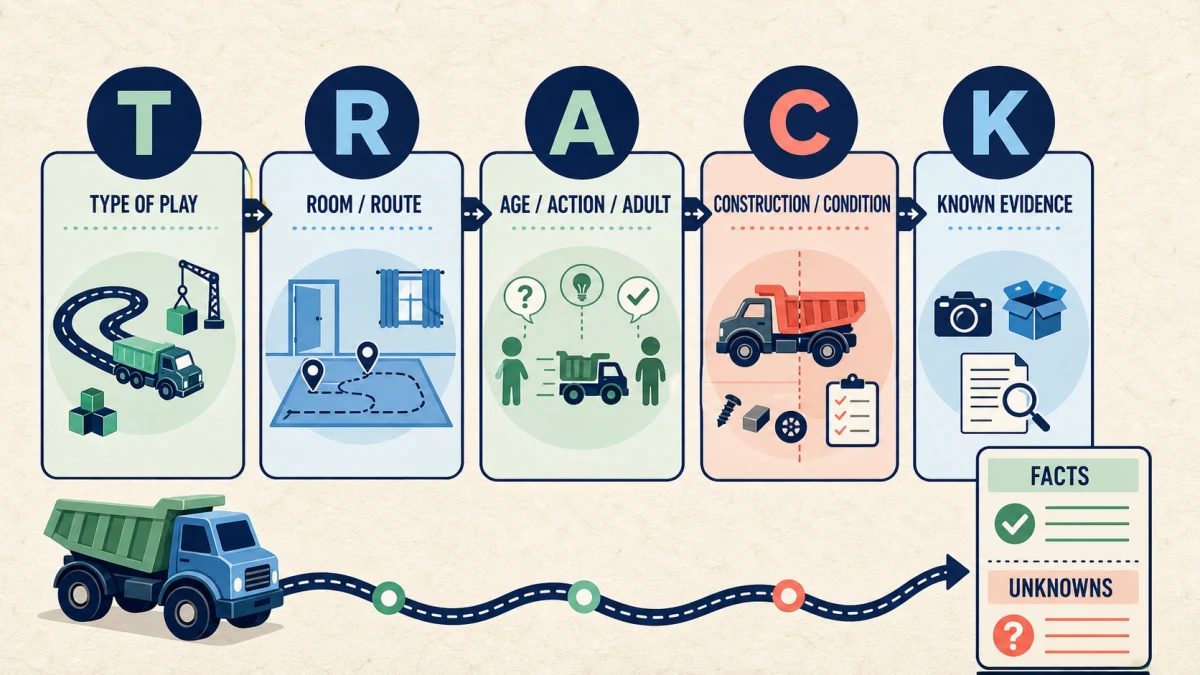
T — Type of play
Does the child want open-ended vehicle stories, repeated races, obstacle design, mechanical curiosity, collecting/display, or remote-control skill? A truck optimized for one may be frustrating for another.
R — Room and route
Map the start, travel, turn, jump, stop, and retrieval areas. Include stairs, roads, water, pets, siblings, fragile objects, and furniture gaps. A fast vehicle that fits on a shelf may not fit the play space.
A — Age, action, and adult role
Follow the exact age grade and warnings. Check required hand strength, winding, controller reading, charging, assembly, and retrieval. State what the adult must do every time.
C — Construction and condition
Inspect wheels, axles, tires, body panels, bumpers, suspension parts if present, decorative pieces, fasteners, gears, battery covers, antennas, remote controls, and projectiles/accessories. Stop at cracks, exposed mechanisms, loose parts, damaged covers, swelling/heat, or abnormal sound/odor.
K — Known evidence
Separate manufacturer facts, official warnings, Find Best Toys observations, and unknowns. Distance, speed, range, runtime, charge time, noise, durability, water resistance, and impact performance require current model evidence and, for comparative conclusions, a defined test protocol.
Match the Truck to the Play Surface
Table or quiet floor
A hand-powered, contained vehicle may suit a smaller route, but hard wheels can be noisy and a heavy truck can damage surfaces or feet. Verify material, weight, and actual use.
Carpet or rug
Pile may change rolling and strain a mechanism or motor. Use only on surfaces permitted by the manufacturer. Do not promise “all-terrain” performance without testing the exact model across defined surfaces.
Yard or paved outdoor area
Grit, water, slope, heat, and longer retrieval distance matter. Verify whether outdoor use is allowed, whether electronics have any relevant protection, and how the truck must be cleaned and dried. “Splash” graphics are not evidence of water resistance.
Ramps and jumps
Check the manufacturer’s intended use. Repeated drops can loosen wheels, axles, body parts, battery covers, and decorations. An impressive marketing photo does not define a safe jump height or landing surface.
Battery and Remote-Control Checks
The CPSC toy-safety guidance identifies battery-operated toys, wheels/axles, projectiles, mechanisms, points, edges, and small objects among feature-specific areas. Requirements depend on the exact toy.
For a battery or RC truck, verify:
- battery chemistry, size, number, orientation, and whether batteries are included;
- whether the child can access the compartment and which tool opens it;
- charging equipment, adult role, approved power source, and current instructions;
- controller battery and any separate button/coin cell;
- what to do after a stall, impact, damaged wire/cover, heat, odor, or swelling;
- indoor/outdoor and water-exposure limits;
- pairing, interference, range, speed, and runtime only from current official material or documented testing.
For button or coin cells, CPSC states toy compartments require a closure opened with a screwdriver, coin, or tool. Consult the Button Cell and Coin Battery Information Center. A damaged or unsecured cover is a stop condition.
Small Parts, Projectiles, and Wear
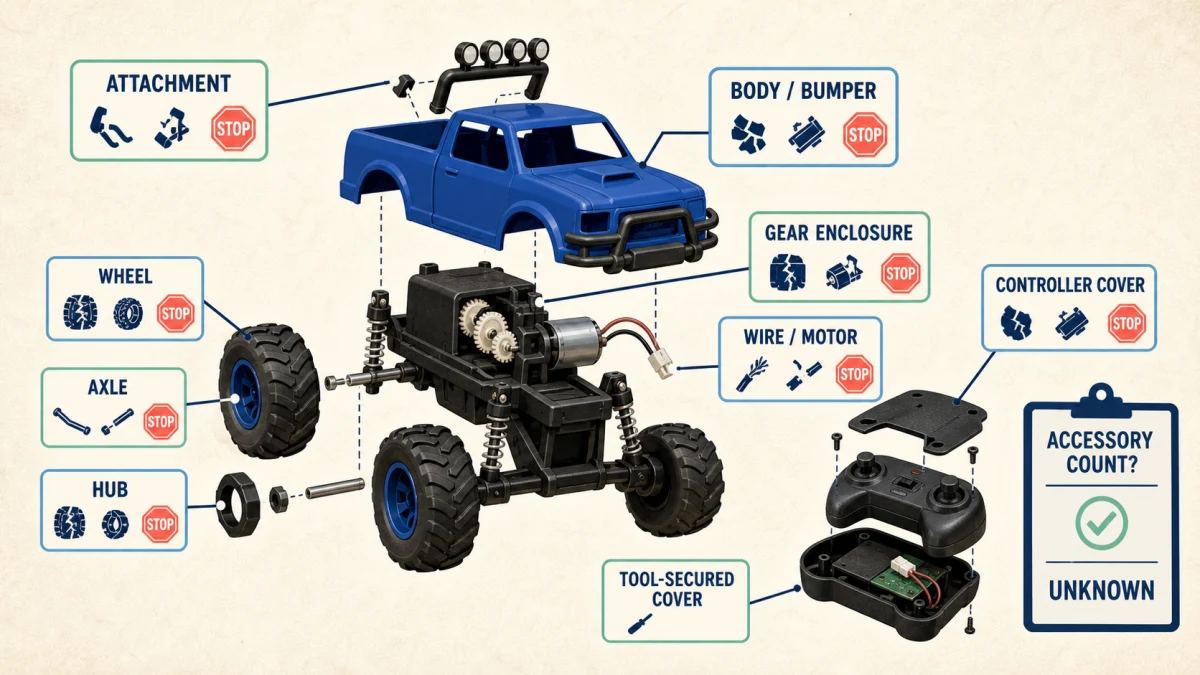
The CPSC small-parts guidance explains the under-three rule and pieces released during applicable testing. Respect the exact age grade, and consider younger siblings and visitors.
Some trucks include cones, barrels, launchers, spare tires, tools, driver figures, or track pieces. Record every included item and its intended use. Do not permit improvised projectiles or parts outside instructions.
After collisions or outdoor use, inspect:
- wheel and axle looseness;
- cracked hubs, tire separation, or sharp body edges;
- exposed gear teeth, wire, or motor area;
- loose lights, mirrors, bumpers, spoilers, exhaust parts, or decals/film;
- battery or controller cover damage;
- missing screws, pins, clips, magnets, or accessories;
- new noise, smell, heat, or erratic movement.
Search the exact model in the live CPSC recalls and product safety warnings database immediately before publication and purchase decisions. A brand-level search is not enough.
Generic, Licensed, and Collectible Intent
This article targets the generic toy category. A licensed entertainment character, real motorsport brand, branded replica, or collectible line can add separate questions: rights-approved naming, exact scale, edition, compatibility, age positioning, model availability, and current manufacturer instructions. Do not mix those claims into generic guidance.
A display collectible is not automatically a children’s toy. Conversely, a children’s toy is not proven collectible because a listing uses “limited.” Treat intended user, safety basis, and commercial claims separately.
A No-Ranking Comparison Card
- Exact model: brand, name, model/SKU, current manufacturer URL.
- Play type: hand-powered, friction, pull-back, wind-up, battery, or RC.
- Dimensions: truck, wheels, controller, and smallest included accessory.
- Intended user: age grade, warnings, skill/reading/assembly demands.
- Setting: allowed surfaces, indoor/outdoor, route and retrieval space.
- Power: battery/charging facts and tool-secured access.
- Construction: wheels, axles, mechanisms, attachments, projectiles, magnets.
- Care: cleaning, water, heat, storage, replacement parts.
- Evidence: manufacturer facts, official sources, documented observations, unknowns.
- Current status: exact-model recall/warning search date and result, never a permanent “recall-free” badge.
Frequently Asked Questions
What size monster truck toy should I buy?
Choose from exact dimensions, the child’s age and grip, smallest included parts, storage, and the active play route. “Mini” or “giant” without measurements is not enough.
Are pull-back and friction trucks the same?
No. Product mechanisms vary. A pull-back model typically stores energy after being pulled backward; a friction/flywheel mechanism is charged through repeated motion. Verify the exact manufacturer description rather than the listing category.
Are RC monster trucks suitable indoors?
Only if the current instructions allow it and speed, route, turning, stopping, noise, retrieval, and surrounding people/objects fit the space. This guide does not approve a category for indoor use.
Is an expensive or licensed truck more durable?
No conclusion follows from price or license. Durability needs construction evidence and a defined test. This guide has no price or test data.
When should a toy truck be retired?
Stop at loose/missing parts, sharp cracks, exposed mechanisms/wires, damaged battery covers, unusual heat/odor/noise, wheel or axle failure, or any manufacturer stop condition or recall instruction.
Choose the Next Step
Choose the motion type and draw the route. Browse the canonical vehicle-toy collection, then use the Toy Finder for age, interest, and setting. Before recommending a model, apply Find Best Toys’ review process and record unknowns instead of inventing performance.
How This Guide Was Prepared—and Its Limits
Find Best Toys Editorial prepared this guide from the dated official sources listed below. It provides general, category-level decision support, names no ranked or hands-on-tested model, and does not replace product instructions or professional advice. No named specialist reviewer is currently listed. Verify the exact product's age label, warnings, instructions, condition, and current recall status before use. We will update this guide when cited guidance or relevant product evidence changes.
References
- CPSC: Toy Safety
- CPSC: Small Parts Ban and Choking Hazard Labeling
- CPSC: Button Cell and Coin Batteries
- CPSC: 2020 Age Determination Guidelines
- CPSC: Recalls and Product Safety Warnings