


# Outdoor Toys for Kids
The right outdoor toy starts with the space, not the size of the box. A ball, bucket, chalk set, balance toy, ride-on, water table, or climbing structure can all support active play, but each needs a different clear area, surface, storage plan, and level of supervision.
Editorial note: Named “best” picks must remain unpublished until the exact products have been assembled, used, weather-exposed where appropriate, and checked for stability and wear.
Key takeaways
- Measure the active play zone, not only the toy's footprint.
- Match height, speed, balance demands, and projectiles to the child and setting.
- Simple portable toys often create more varied play than large fixed equipment.
- Check drainage, UV exposure, anchors, hardware, pinch points, and storage.
- Separate backyard toys from public playground equipment; different guidance may apply.
- Reinspect outdoor toys because weather and movement can change them.
What features should I look for when buying outdoor toys for kids?
Look for a clear age range, stable construction, enough run-out space, surfaces suited to the activity, weather-resistant materials, practical storage, and instructions that match your setting. Also consider how many children will use it, where adults can stand, how it drains and dries, and what routine inspection it requires.
For larger equipment, use the manufacturer's installation instructions and applicable local requirements. The CPSC's Outdoor Home Playground Safety Handbook is a useful starting point for residential playground equipment; it is not a substitute for product-specific instructions.
How much space does an outdoor toy need?
The usable space must include the child's movement around the toy, not just the product's dimensions. A slide needs an exit area. A swing needs a moving-use zone. A throwing game needs separation from windows, roads, pets, and people who are not playing.
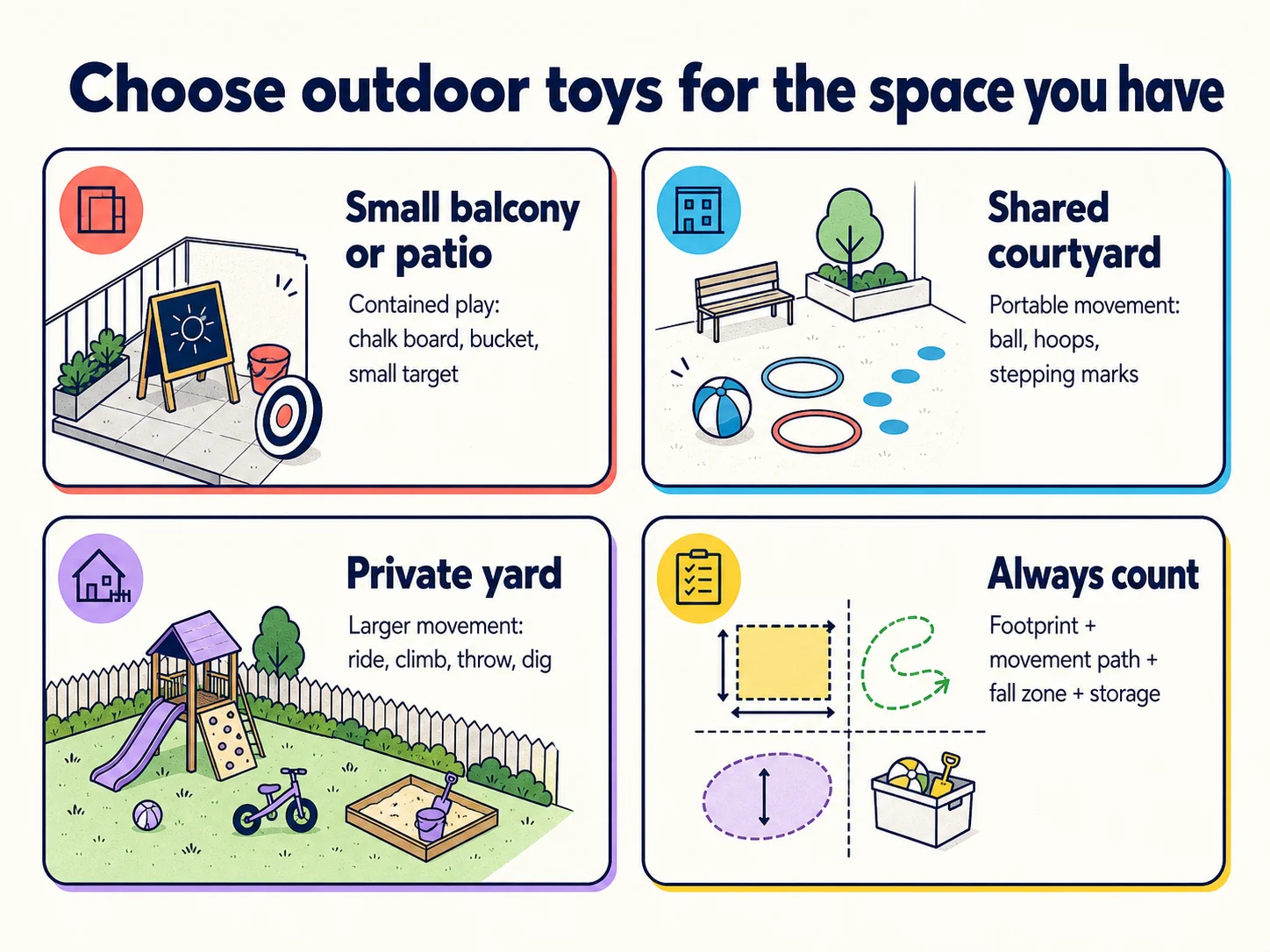
Before buying, sketch the space and mark:
- the toy footprint;
- the child's likely path of travel;
- doors, steps, walls, fences, pools, and hard edges;
- the adult's sightline;
- where the product will go when not in use.
If the activity cannot fit without overlapping another child's path, choose a smaller or more portable option.
Which outdoor toys work in small spaces?
Good small-space outdoor toys create movement without requiring a permanent structure. Sidewalk chalk, soft balls used with a clear boundary, buckets, watering tools, large loose parts, stepping markers, and simple target games can all be adapted to the available area.
The important distinction is between portable and uncontrolled. A light object that blows into a road or a ball that repeatedly enters another household's space is not a good fit. Test the real boundary before giving the toy to a child.
How should age and movement confidence affect the choice?
Choose an activity the child can enter and exit safely at their current level of balance, strength, and judgment. Do not buy a tall or fast product simply because the child may “grow into it.” Age labels remain the starting point, but the environment and the way the toy will be used also matter.
For ride-ons and balance toys, inspect steering limits, wheel width, tipping behavior, foot placement, and the required protective equipment. For water play, plan active supervision, emptying, and drying before the toy arrives.
Which materials hold up outdoors?
No material is weatherproof forever. Sunlight can fade or embrittle plastic. Water can enter hollow parts, swell wood, or corrode hardware. Grit can jam wheels and hinges.
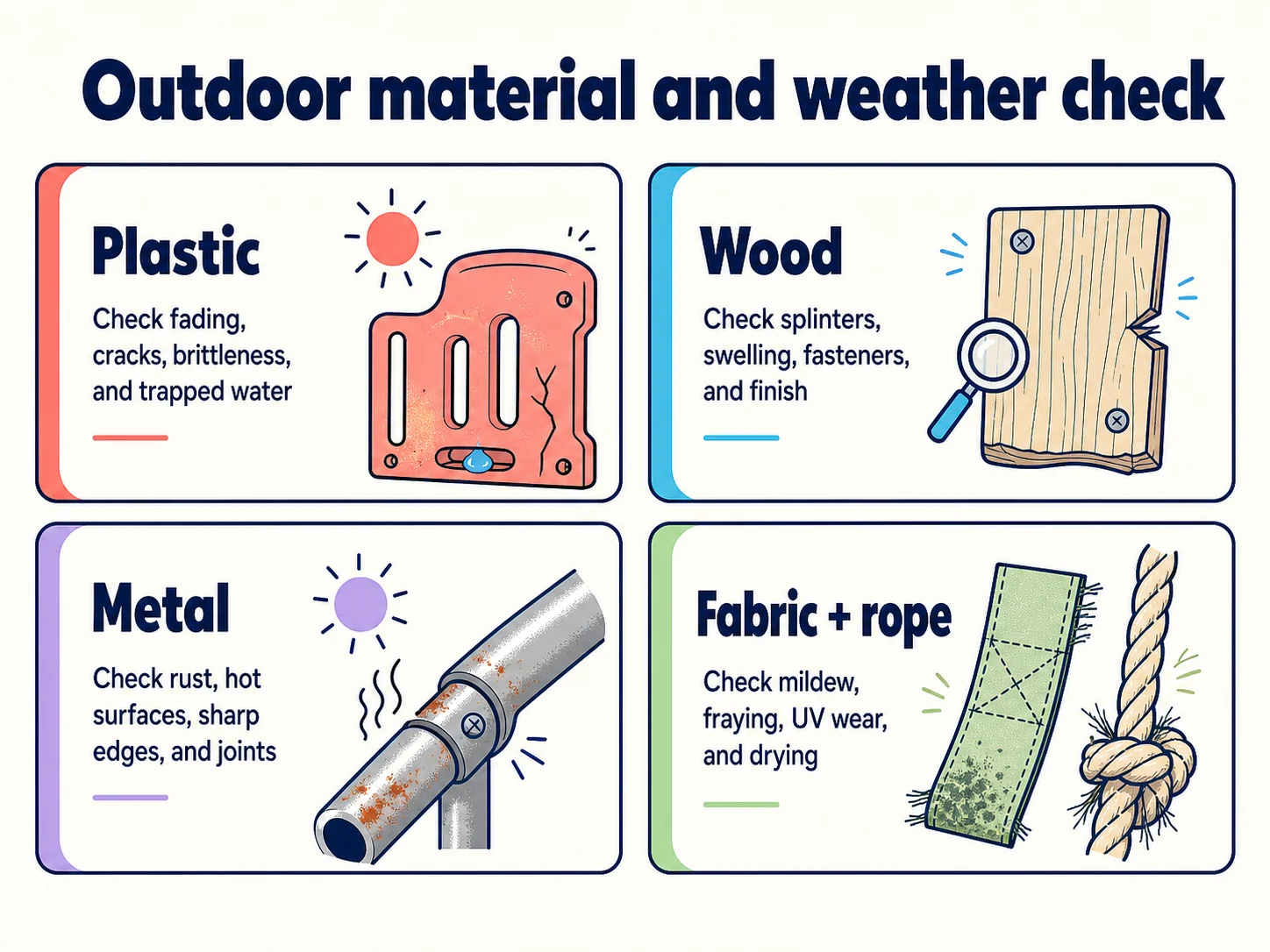
Ask four questions:
- Can water drain completely?
- Can hidden areas be inspected and dried?
- Are replacement parts and hardware available?
- Does the manufacturer explain indoor storage, covers, anchoring, or seasonal maintenance?
“Outdoor” on the box is not a maintenance plan.
What are the main outdoor-toy safety checks?
Check stability, moving clearances, impact areas, entrapment openings, cords, sharp edges, hot surfaces, projectiles, and emerging wear. Stop using a product if anchors loosen, plastic cracks, hardware protrudes, ropes fray, or a part no longer moves as designed.
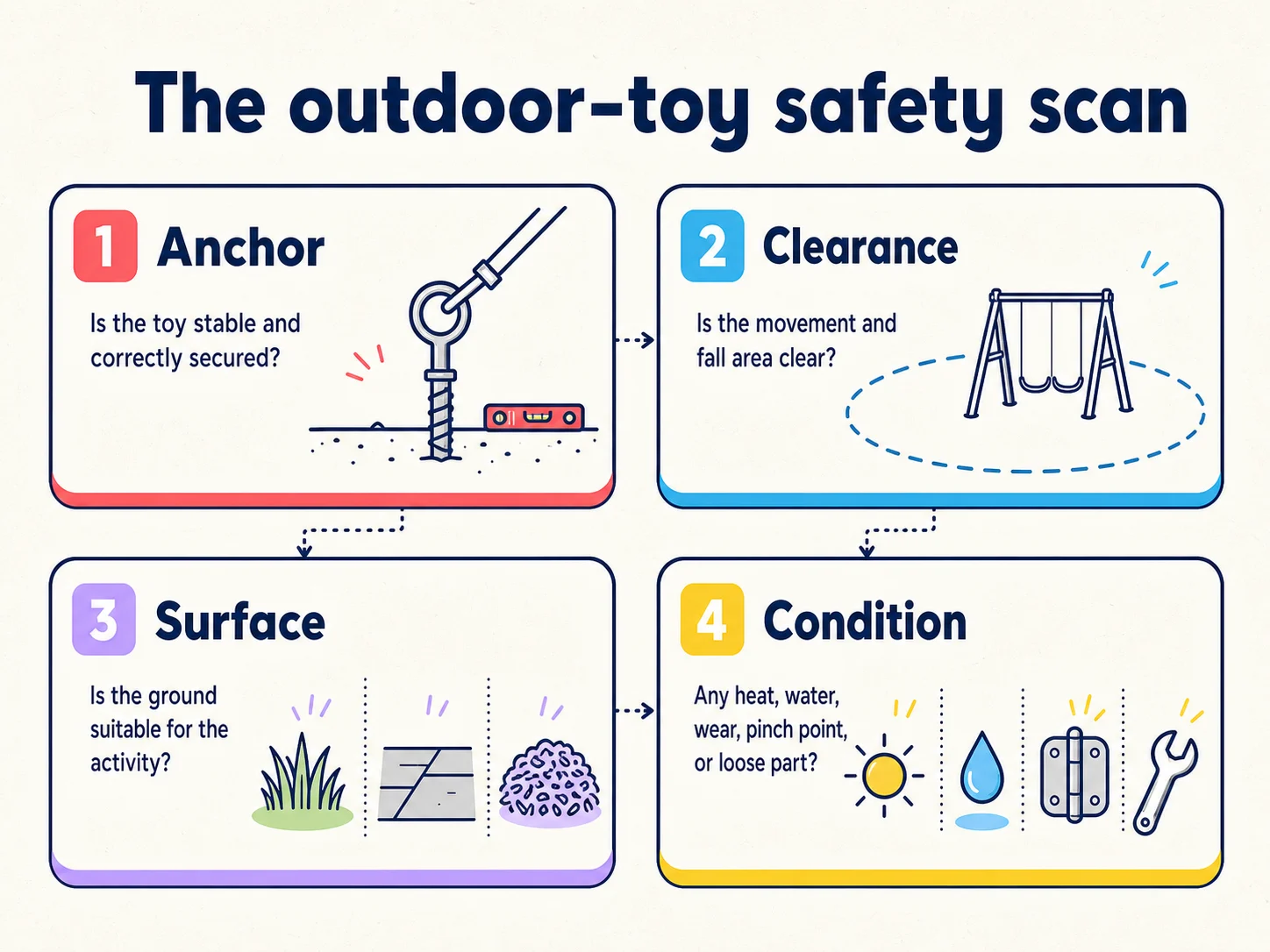
The CPSC's current Public Playground Safety Handbook addresses public equipment and highlights the importance of layout, maintenance, and impact-attenuating surfaces. Home toys vary widely, so follow the specific manual and any relevant local rules.
Search the CPSC recall database before buying used equipment and periodically afterward. Use the exact brand and model; a visually similar product may have different hardware or warnings.
How should Play Atlas test outdoor toys?
For each named recommendation, the public record should include:
- assembled dimensions and required use zone;
- assembly time, missing tools, and ambiguous instructions;
- stability on each permitted surface;
- realistic child capacity and adult sightlines;
- water drainage, cleaning, storage, and weather exposure;
- loose hardware, cracks, sharp points, pinch areas, and fading;
- the test date, setting, sample source, and limitations.
A product should not be ranked merely because it photographs well in a large yard.
Frequently asked questions
Are expensive outdoor toys better?
Not automatically. Price may reflect size, material, shipping, or branding. Compare repeatable play, setup friction, repairability, storage, and safe fit for the actual space.
What are good screen-free outdoor toys?
Balls, chalk, buckets, large loose parts, simple targets, kites for suitable ages, and movement prompts can support varied play without a screen. Choose according to age, location, weather, and supervision.
Can outdoor toys be left outside all year?
Only if the manufacturer permits it and the product is still inspected. Weather exposure can create hazards that were not present when the toy was new.
Choose for the space you have
Start with the available area, the movement you want to invite, and the storage you can maintain. Explore more options through the Toy Finder or compare age-specific choices in the Toys for 1-Year-Olds hub.