


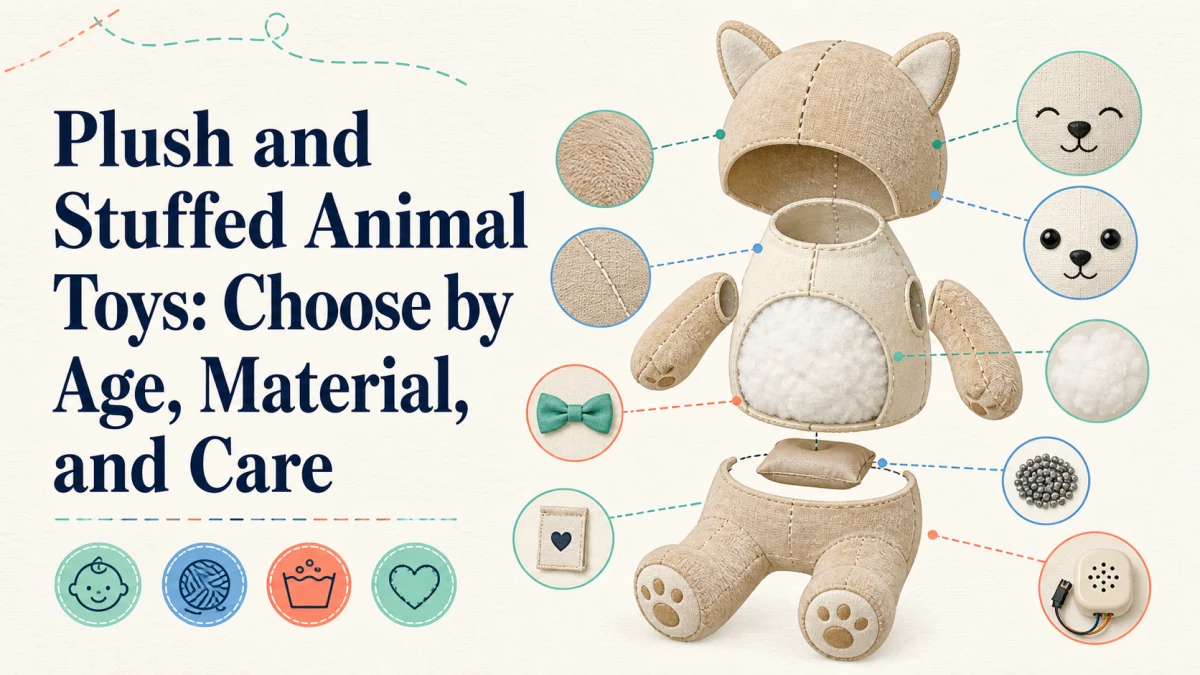
Choose plush stuffed animals toys by intended age, exact size, surface fabric, seams, filling, attachments, care instructions, and where the toy will be used. Softness is a feel, not proof that eyes, noses, accessories, pellets, batteries, seams, or coatings are appropriate for a child. Verify the exact model and inspect it after washing and wear. This guide compares construction and use; Find Best Toys has not tested, ranked, certified, or confirmed the safety of any plush product.
Key Takeaways
- Start with intended user and use—not color, character, “cuddly,” or “collectible.”
- Verify exact dimensions, exterior materials, filling, weighted material, attachments, electronics, and care label.
- Embroidered features can reduce some attachment questions but do not verify the complete toy.
- Follow one exact cleaning method; “washable” without temperature, cycle, drying, and component instructions is incomplete.
- Retire or isolate a toy at split seams, exposed filling, loose attachments, damaged electronics, degraded surfaces, or recall instructions.
Soft Toys Are Not One Construction
The category includes simple fabric animals, long-pile characters, beanbag forms, weighted products, puppets, reversible plush, clip-on toys, sound or light products, scented products, and display collectibles. Each adds different questions.
Use the plush-toy collection to browse the category, then build an exact construction record:
| Component | What to record | Why it changes the decision | Unknown until verified |
|---|---|---|---|
| Exterior | Fiber/material statement, pile length, printed/coated areas | Feel, debris retention, cleaning, wear | Actual wash durability, shedding, chemical composition |
| Filling | Fiberfill, foam, pellets, weighted insert, electronics | Shape, weight, leak/failure consequences | Exact composition and containment without manufacturer evidence |
| Seams | Location, stitch type description, stress areas, repair instruction | Openings can expose filling or internal parts | Strength and durability without inspection/testing |
| Face/details | Embroidery, plastic eyes/nose, glued or sewn decoration | Attachments can loosen or create hard points | Retention after use/cleaning without evidence |
| Accessories | Clothing, ribbons, loops, bells, clips, bags, tools | Adds small parts, cords, snagging, storage | Whether every accessory is intended for the same age |
| Electronics | Sound box, light, battery compartment, wires, switches | Adds battery, heat, cleaning, and damage questions | Current battery and enclosure facts without exact model |
| Size/weight | Length, width, height, weight, smallest part | Affects grip, carrying, storage, impact, and use context | “Large” or “mini” is not a measurement |
| Care | Wipe, hand wash, machine cycle, removable module, drying | Wrong cleaning can damage materials or containment | “Washable” is not a complete method |
The current page owns product collection intent; this article owns the selection, care, and retirement framework.
Use the STITCH Framework
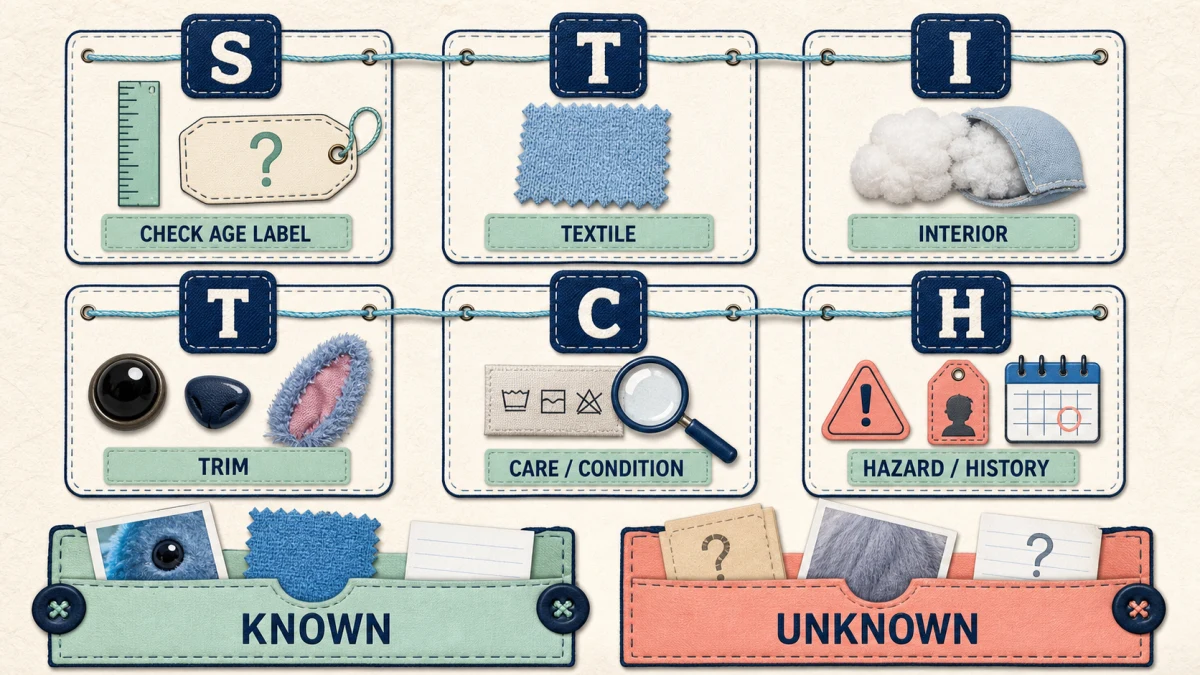
S — Size and intended user
Record exact dimensions and age grade. Consider the full toy, smallest accessory, weight, and how it will be carried or thrown. Follow the age grade; do not move a display collectible or older-child product into a younger child’s environment because the body feels soft.
T — Textile and surface
Verify the manufacturer’s exterior material statement and any coated, printed, glittered, fuzzy, faux-fur, or scented area. Look for shedding, peeling, sticky change, matting, or exposed backing after use and cleaning.
I — Interior and inserts
Identify filling, pellets, weighted components, sound units, wires, squeakers, magnets, and batteries. If the description does not name the internal construction, record it as unknown. Never infer “hypoallergenic,” “non-toxic,” or “safe filling.”
T — Tethers, trim, and attachments
Check eyes, noses, horns, claws, whiskers, ribbons, loops, zippers, snaps, hook-and-loop patches, clothing, tags, and clips. Embroidery may eliminate a separate plastic eye, but every seam, thread, coating, and accessory still needs review.
C — Care and condition
Follow the exact method and inspect afterward. A toy that remains damp, changes texture, clumps internally, exposes a component, or loses attachment security needs action under manufacturer instructions.
H — Hazards, history, and handoff
Check warnings and current recall status. For secondhand or inherited toys, verify exact identity and current instructions if possible; inspect past repairs, missing labels, odor, stains, pest exposure, degraded foam, loose stuffing, and replacement accessories. Sentimental value does not restore missing evidence.
Age Labeling and Small Parts Still Matter
The CPSC toy-safety page explains that the toy standard includes feature-specific provisions, including stuffing materials and stuffed/beanbag-type toys, along with small objects, points, edges, cords, batteries, magnets, and other hazards where applicable. A consumer-facing guide cannot certify compliance from touch or photographs.
For products intended for children under three, the CPSC small-parts guidance explains the applicable small-parts ban and includes pieces released during testing. A large stuffed body can still have a small eye, zipper pull, bell, clip, pellet, battery, or decoration.
The American Academy of Pediatrics’ safe-toy buying guidance recommends using age recommendations to help judge safety and whether a toy fits a child’s abilities and interests. It also directs families to act on recalls. These sources support an age-and-construction check, not a blanket statement that any fabric toy is safe.
Cleaning: Follow the Label, Then Reinspect
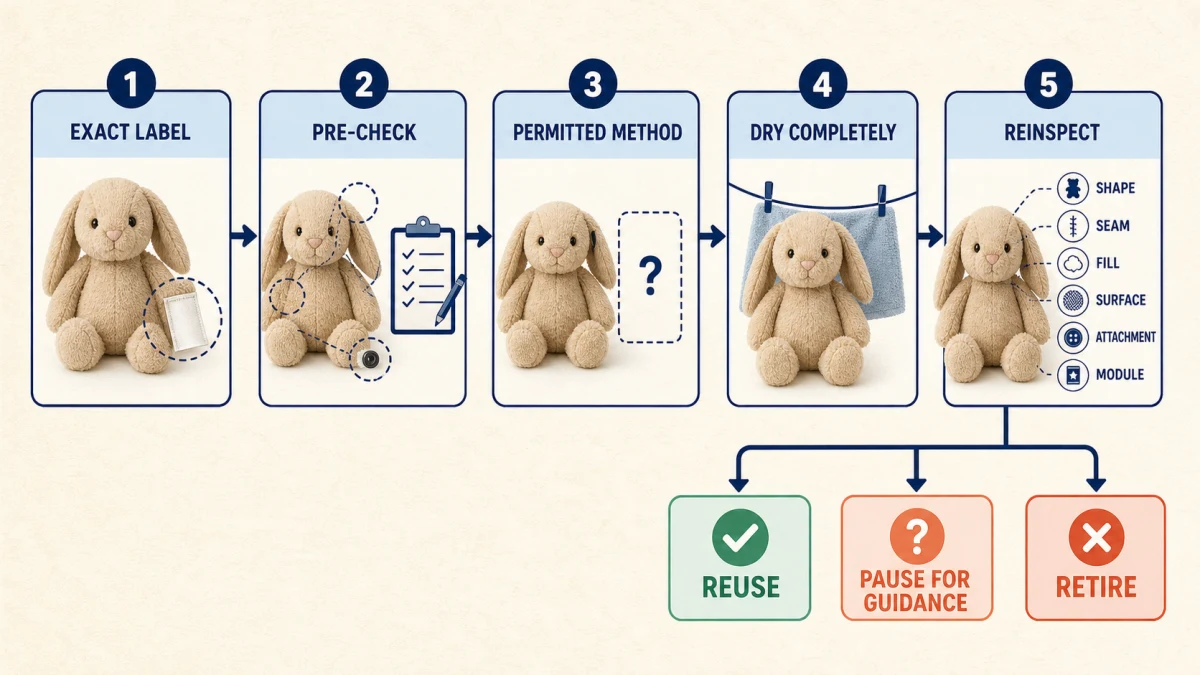
“Machine washable” still needs the exact cycle, temperature, detergent, enclosure, and drying method. “Surface clean” does not mean soak. A removable electronic module must be handled only as instructed. A weighted or pellet-filled toy may have different care from fiberfill.
Before cleaning
- Identify the exact model and read current instructions.
- Photograph or note seams, attachments, shape, and component position.
- Check for existing openings, loose trim, stains, odor, or damaged electronics.
- Remove a module or accessory only when the instructions say to do so.
During cleaning
Use only the stated method. Do not invent a universal disinfectant, heat, freezer, steam, immersion, or drying technique. Material compatibility and internal construction are model facts.
After cleaning
Wait until the product is fully dry under the stated method. Then check:
- seam and attachment movement;
- exposed thread, backing, foam, pellets, fill, wire, or module;
- new hard lumps, clumping, uneven weight, odor, or retained moisture;
- cracked plastic, faded/peeling coating, sticky surface, or shed fibers;
- battery cover, switch, sound, and heat if electronics remain, following instructions.
If the condition changed, stop use until manufacturer direction or appropriate disposal/repair guidance is clear.
Sleep, Comfort, and Marketing Boundaries
This guide does not provide infant or child sleep-safety advice and does not recommend placing a plush toy in a sleep space. Any statement about sleep use requires current age-specific medical/safety guidance and a pediatric reviewer; the word “comfort,” a bedtime photo, or a child’s preference is not enough.
Similarly, do not promise that a plush product treats anxiety, supports attachment, improves sleep, or provides therapeutic pressure. A person may value or prefer an object, but an individual preference is not a general health outcome.
If size, weight, scent, heat, electronics, or a weighted insert is marketed for a therapeutic purpose, route the claim to a qualified reviewer and require claim-level evidence. Do not inherit the manufacturer’s wording uncritically.
Secondhand, Repair, and Modification
Secondhand plush can be practical, but it adds identity and condition uncertainty. Do not rely on appearance alone.
- Locate the product label, brand, model or collection, and manufacturing information when available.
- Search the exact identity in CPSC recalls and product safety warnings.
- Compare accessories and instructions with current official information.
- Treat missing eyes, clothes, modules, or fasteners as condition changes, not customization.
- Do not add homemade buttons, beads, magnets, heat packs, scent, weights, cords, or electronics; modification changes the construction and evidence basis.
- A repair should follow manufacturer guidance or be evaluated by an appropriate qualified service. A hidden stitch does not prove restored safety or wash durability.
Recall data is time-sensitive. Record the search date and result, and recheck shortly before publication or recommendation.
Five-Minute Plush Inspection
- [ ] Exact identity, age grade, warnings, dimensions, and care label are available.
- [ ] Exterior, filling, weighted material, attachments, accessories, and electronics are described.
- [ ] Seams are closed with no stretched holes, exposed fill, or loose thread loops.
- [ ] Eyes, nose, trim, clothing, clips, zippers, and decorations do not move unexpectedly.
- [ ] No battery, magnet, pellet, bell, wire, squeaker, or hard insert is accessible or missing.
- [ ] Surface is free of sticky degradation, peeling, sharp plastic, abnormal shedding, dampness, or odor change.
- [ ] Cleaning followed the exact label, and the product is fully dry.
- [ ] The exact model has a current CPSC recall/warning check.
- [ ] Any sleep or therapeutic wording has separate current evidence and qualified review.
Suitable, Unsuitable, and Still Unknown
Suitable for consideration
The exact model is age-graded for the user, complete construction and care facts are available, attachments and seams can be inspected, the setting is appropriate, and current recall checks are complete.
Unsuitable in the intended context
The toy is a display collectible or older-age product; has loose or missing parts; cannot be cleaned as required; contains inaccessible-to-review electronics or filling; is damaged; or is proposed for sleep/therapy without appropriate guidance.
Still unknown
Material chemistry, actual seam strength, shedding, wash durability, claim efficacy, certification, and long-term wear remain unknown without exact evidence. Record unknowns rather than translating “premium,” “eco,” “hypoallergenic,” or “cuddly” into facts.
Frequently Asked Questions
Are embroidered eyes always safer than plastic eyes?
Embroidery removes one type of separate hard attachment, but it does not verify thread security, seams, filling, trim, coatings, accessories, age grade, or the complete toy. Evaluate the whole construction.
Can every stuffed animal go in a washing machine?
No. Follow the exact care label. Electronics, weighted inserts, pellets, adhesives, coatings, foam, and fabric can require different methods.
Are weighted stuffed animals suitable for children?
This guide does not make a category recommendation. Verify the exact intended user, age, weight, filling, instructions, warnings, and evidence for any claimed benefit, and obtain qualified guidance when health or therapeutic use is implied.
How do I check a stuffed animal for recalls?
Use the exact brand, product name, model/SKU, and label details in the CPSC search. Record the date, read the full remedy, and recheck before publication because status information can change.
When should a plush toy be retired?
Follow manufacturer instructions and stop at exposed filling, split seams, loose/missing attachments, damaged electronics or battery cover, accessible magnet/pellet, sharp area, degraded surface, retained moisture, or recall direction.
Choose the Next Step
Build the STITCH record before choosing a character or color. Browse the plush-toy collection, then use the Gift Finder to clarify age and occasion. Review Find Best Toys’ safety and source policy and keep every model-level unknown visible.
How This Guide Was Prepared—and Its Limits
Find Best Toys Editorial prepared this guide from the dated official sources listed below. It provides general, category-level decision support, names no ranked or hands-on-tested model, and does not replace product instructions or professional advice. No named specialist reviewer is currently listed. Verify the exact product's age label, warnings, instructions, condition, and current recall status before use. We will update this guide when cited guidance or relevant product evidence changes.
References
- CPSC: Toy Safety
- CPSC: Small Parts Ban and Choking Hazard Labeling
- CPSC: 2020 Age Determination Guidelines
- CPSC: Recalls and Product Safety Warnings
- American Academy of Pediatrics: How to Buy Safe Toys