


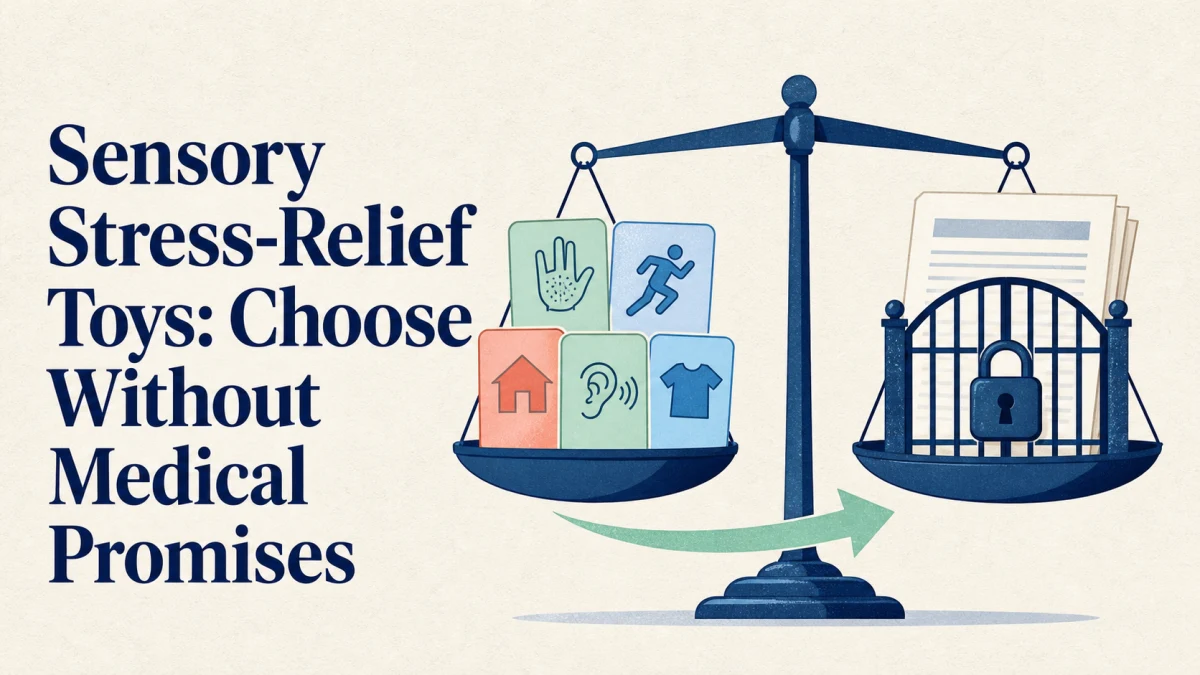
The phrase sensory stress relief toys describes a shopping intent, not a proven treatment category. Choose by the input a product offers—slow resistance, repetitive motion, texture, sound, or whole-body movement—and by where it will be used. Then verify age fit, noise, interruption, rolling or loose parts, construction, cleaning, and wear. Do not promise calm, focus, anxiety relief, regulation, or therapy from a category label. This guide helps compare options; it does not diagnose a need, test products, or rank outcomes.
Key Takeaways
- Translate “stress relief” into a specific input, action, and situation.
- Separate a person’s preference from an outcome claim: liking a motion does not prove treatment.
- Decide whether the object may be used at a desk, during travel, in a group, outdoors, or only with direct supervision.
- Treat water beads, accessible batteries, loose magnets, leaking fillings, and changing parts as high-risk exclusions or stop conditions.
- Publication of any named product requires current model evidence and qualified review of every mental-health or sensory claim.
Begin with the Claim Ladder
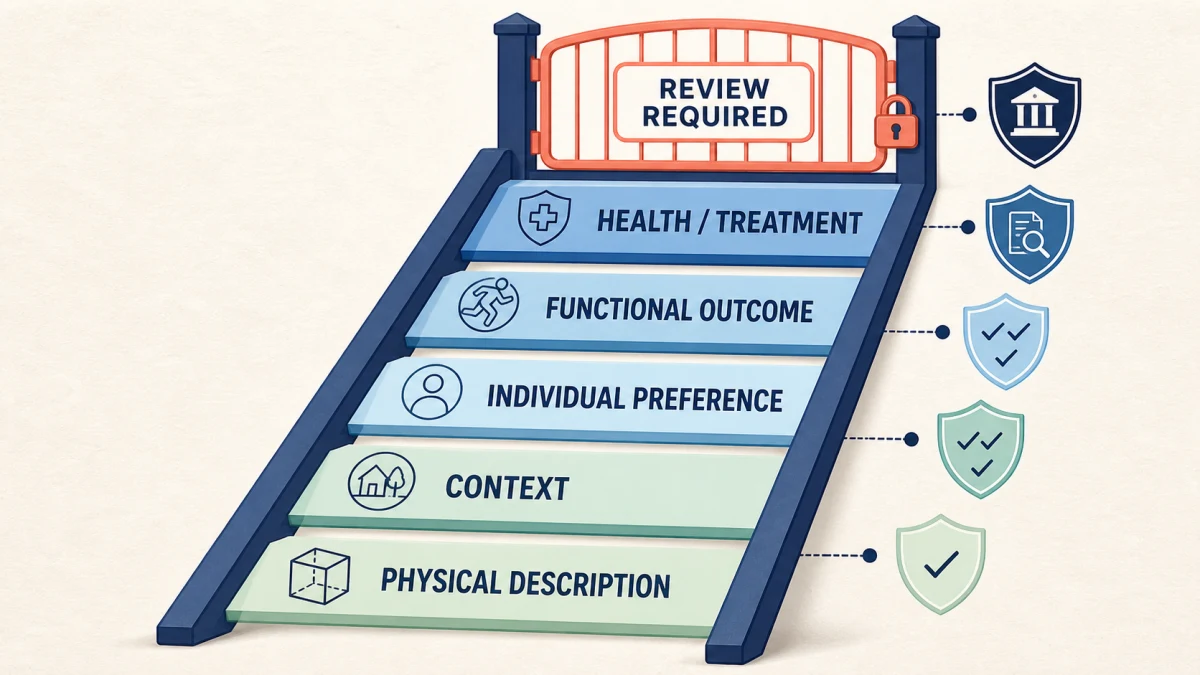
Not all wording carries the same evidence burden. Use this ladder before drafting a product description.
| Claim level | Example | Evidence status in this article | Editorial treatment |
|---|---|---|---|
| Physical description | “Offers slow squeeze resistance” | Observable but still model-specific | Verify construction and actual action |
| Context description | “Sized for a desk and has no electronic sound” | Model- and use-specific | Verify dimensions, mechanism, and real noise |
| Preference report | “The user prefers this texture” | Individual observation | Attribute to the individual; do not generalize |
| Functional outcome | “Helps the user return to a task” | Needs appropriate observation and context | Do not promise; define who observed what and when |
| Health or treatment claim | “Treats anxiety” or “regulates the nervous system” | Not supported by this evidence set | Exclude unless separately substantiated and clinically reviewed |
Most buying guides can stay on the first two levels. They can explain the input, use conditions, and trade-offs without predicting what it will do to a person.
The Sensory and Fidget Hub remains the broad collection owner. This article owns the narrower evaluation question behind the exact query, while the sensory-and-fidget type page organizes products by type.
Define the Job Before the Object
Write the situation in neutral language:
- “A quiet hand activity during a waiting period.”
- “A durable object for repeated squeezing at home.”
- “A movement option during a planned break.”
- “A contained tactile activity that can be cleaned between users.”
- “A non-rolling object that can remain on one desk.”
Avoid “a toy that stops a meltdown,” “keeps a child focused,” or “reduces anxiety.” Those statements assign a behavioral or health outcome before the individual, environment, trigger, and evidence are understood.
For a child with an individualized school, therapy, or health plan, the plan and qualified team take priority over a generic shopping article. The person using the object should have a meaningful choice whenever possible.
Compare Input Families Without Ranking Them
| Input family | Observable action | Potential context | Trade-offs | Critical checks |
|---|---|---|---|---|
| Slow resistance | Squeeze, press, stretch as intended | Home, planned break, some desk use | Skin/seam wear, filling, mouthing, fatigue | Complete material/filling statement, age grade, failure response, cleaning |
| Repetitive mechanism | Spin, slide, roll within a track, click | Seated waiting or desk use | Sound, distraction, pinch points, loose caps | Noise, mechanism enclosure, fasteners, small parts |
| Tactile surface | Rub, trace, stroke, press | Quiet area, bag, shared station if cleanable | Debris, peeling, texture aversion | Surface attachment, care method, material change with cleaning |
| Manipulation puzzle | Fit, fold, link, turn, sequence | Longer waiting or individual challenge | Cognitive load may compete with the primary task | Piece containment, reading/rule load, reset, age fit |
| Whole-body movement | Push, carry, balance, stretch, move through space | Planned movement area | Requires space, supervision, equipment and social rules | Intended use, load, surface, stability, surrounding hazards |
| Sound or rhythm | Shake, tap, listen, repeat | Music or intentional sound setting | Can disturb others or overwhelm the user | Volume, proximity to ear, battery access, setting permission |
No row is “best.” A quiet shared classroom, a private home, a vehicle, and a movement room have different constraints. The quiet-time collection can supply context, but “quiet” must still be checked on the exact model and surface.
Apply the INPUT Check
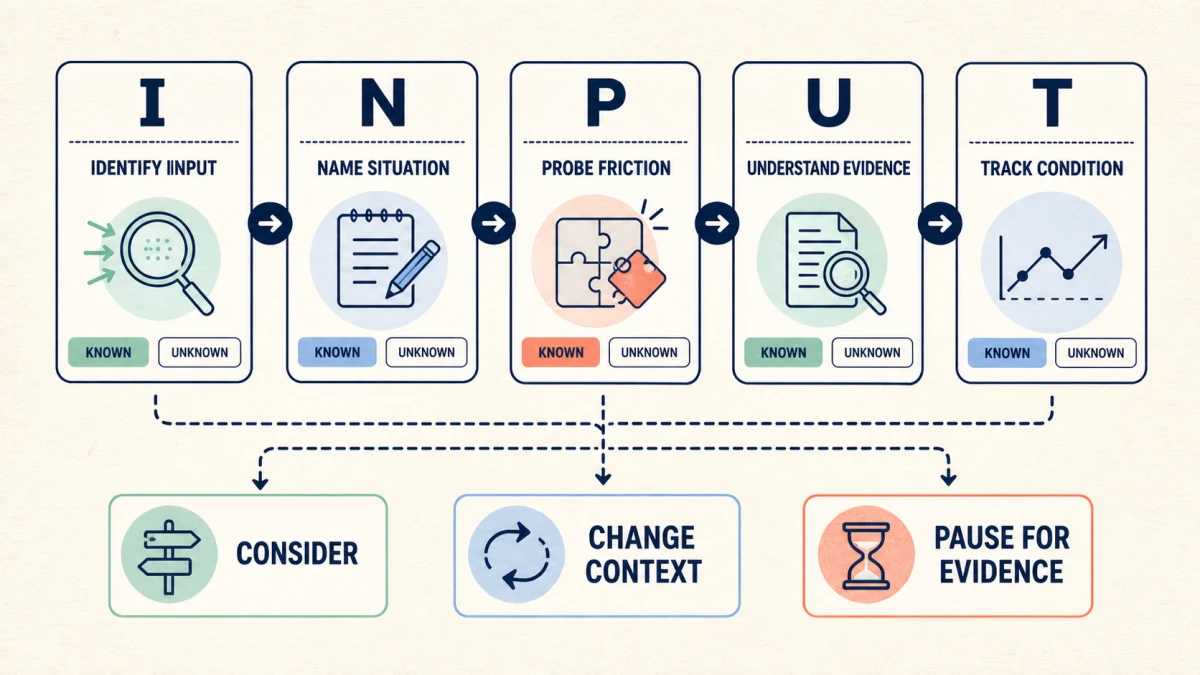
I — Identify the physical input
Name resistance, texture, motion, sound, pressure, or movement. Reject descriptions that rely entirely on the word sensory.
N — Name the situation and consent
Where, when, and for how long might the object be available? Can the user decline or stop? Who stores and cleans it? In a classroom, what rules protect the user and other people from noise, thrown objects, or shared hygiene issues?
P — Probe practical friction
Check rolling, drop noise, pieces, leakage, odor, charging, storage, cleaning, replacement, and how easily the item becomes lost. An object that creates conflict or constant adult policing may not solve the intended practical job.
U — Understand the evidence boundary
Record only what is verified: material, dimensions, mechanism, instructions, age grade, warnings, and observed use. “Designed for stress relief” is a manufacturer positioning statement unless a specific supported claim exists.
T — Track condition over time
Set inspection and stop rules. Repetitive use can change seams, skins, caps, pivots, surfaces, batteries, and magnets. A product can become unsuitable even if it still produces the intended motion.
Safety Checks That Marketing Language Cannot Replace
The CPSC toy-safety overview explains that different toy features are subject to different requirements. For children’s products, verify the precise model, intended age, and applicable information. For a general-use object marketed to adults, do not assume it meets the requirements for a child’s toy.
Exclude water beads
CPSC’s Water Beads Information Center currently urges parents and caregivers to remove water beads from environments with children. Do not recommend them as a stress or sensory tool for children, even with a supervision caveat.
Secure batteries
For a toy using button or coin cells, CPSC states the compartment requires a secure closure opened with a screwdriver, coin, or tool. Review the current battery guidance. Stop using a product if the compartment or cover is damaged.
Treat loose magnets as urgent
The CPSC magnets center documents ingestion hazards and current warnings. A missing, loose, or accessible magnet is not ordinary wear.
Inspect filled and mechanical objects
For a filled squeeze product, verify the complete exterior and filling description, seam or valve construction, care method, and what the manufacturer says to do after damage. For a mechanism, inspect caps, axles, pivots, tracks, covers, and new sounds. The live sensory and squishy-toy safety guide owns the detailed seam/cleaning/retirement framework.
Check the exact model in CPSC recalls and product safety warnings shortly before publishing or recommending it. Recall information is time-sensitive.
Run a Small, Reversible Trial
This is an observation process, not a clinical test.
- Choose one clearly described, age-appropriate input.
- Set a short, ordinary context without promising an outcome.
- Let the user choose whether and how to engage within safe instructions.
- Observe practical facts: use, refusal, noise, dropping, conflict, cleanup, and product wear.
- Ask the user what they noticed when communication and context allow.
- Keep, change, or remove the object based on preference, safety, and practicality.
- Escalate health, developmental, behavioral, or school concerns to qualified people rather than adding stronger product claims.
Do not publish a personal observation as a general result. “One child used it during homework” does not prove attention improvement.
A Buyer and Editor Checklist
- [ ] The input and action are described without an outcome promise.
- [ ] The intended user and age are clear.
- [ ] The use setting, noise, rolling, throwing, hygiene, and storage are considered.
- [ ] Exact dimensions, materials/filling, mechanism, batteries, and magnets are known where relevant.
- [ ] Current instructions, warnings, cleaning, and retirement signs are available.
- [ ] The exact model has a fresh CPSC recall/warning search.
- [ ] The description does not imply diagnosis, treatment, guaranteed calm, or improved focus.
- [ ] Any functional or health claim has source-level evidence and qualified reviewer sign-off.
- [ ] The user can stop or choose another option.
Suitable, Unsuitable, and Unverified
Suitable for consideration
The object has a clearly described input, verified intended age/use, manageable setting demands, complete instructions, and a construction that can be inspected. The user’s preference—not the label—supports continued availability.
Unsuitable for the intended job
It is too noisy, rolls away, requires forbidden loose media, becomes a projectile, cannot be cleaned as required, conflicts with an individual plan, or needs constant adult enforcement.
Unverified
Composition, certification, outcome, noise, durability, privacy, or current recall status is missing. Do not convert “unknown” into “safe,” “non-toxic,” “therapeutic,” or “effective.”
Frequently Asked Questions
Do sensory toys reduce stress?
This guide does not make that claim. A person may prefer a particular input or use an object in a routine, but treatment or guaranteed outcome claims need evidence and qualified review.
What is the difference between a sensory toy and a fidget toy?
The labels overlap. “Sensory” may describe many input types; “fidget” often describes repetitive hand manipulation. Evaluate the physical action and setting instead of relying on the label.
Can a teacher give the same fidget to every student?
A generic product rule may not fit individual preferences, needs, classroom plans, noise, hygiene, or safety. Coordinate with the student, family, educators, and relevant professionals.
Are adult stress toys safe for children?
Do not assume so. A general-use product may have a different intended user, pieces, labeling, or safety basis. Use a product explicitly age-graded for the child and verify the exact model.
When should a filled or mechanical sensory object be retired?
At any critical change: leak, split seam, loose cap, exposed mechanism, missing piece, damaged battery cover, accessible magnet, sharp area, degraded surface, or manufacturer stop condition.
Choose the Next Step
Define one neutral job and one input. Use the Toy Finder to narrow by age and setting, then compare every exact model against Find Best Toys’ editorial standards and safety/source policy. For an individualized need, take the job statement—not a product promise—to the relevant qualified professional.
How This Guide Was Prepared—and Its Limits
Find Best Toys Editorial prepared this guide from the dated official sources listed below. It provides general, category-level decision support, names no ranked or hands-on-tested model, and does not replace product instructions or professional advice. No named specialist reviewer is currently listed. Verify the exact product's age label, warnings, instructions, condition, and current recall status before use. We will update this guide when cited guidance or relevant product evidence changes.
References
- CPSC: Toy Safety
- CPSC: Button Cell and Coin Batteries
- CPSC: Magnets
- CPSC: Water Beads
- CPSC: Recalls and Product Safety Warnings
- American Academy of Pediatrics: Toy Buying Tips for Babies and Young Children