


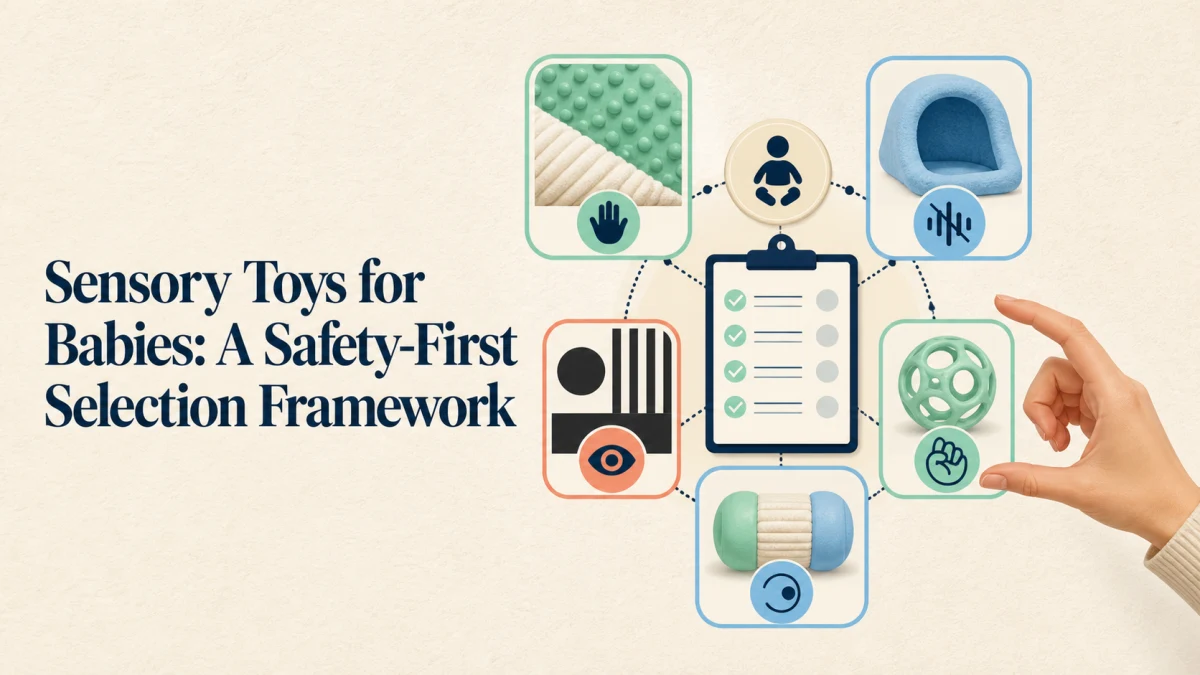
Choose sensory toys for babies by the specific input and action: a textured surface to touch, a quiet sound produced by movement, a high-contrast shape to look at, or a large object to grasp and pass between hands. For babies, “sensory” never overrides age grading, mouthing risk, small-parts rules, battery or magnet containment, cleaning instructions, and close supervision. Avoid loose fillers and water beads. This guide offers a category framework only; it has not tested, certified, or recommended any product.
Key Takeaways
- Name the input—texture, visual contrast, sound, resistance, motion, or temperature—rather than accepting “sensory” as a benefit claim.
- Prefer one clear action and an observable response over a crowded feature panel.
- Assume mouthing, dropping, pulling, and repeated impact are part of foreseeable baby use.
- Do not use water beads as baby sensory material; follow current CPSC warnings.
- Verify the exact model’s age grade, dimensions, attachments, materials, care method, battery closure, warnings, and current recall status.
“Sensory” Describes Input, Not a Safety Category
The word can cover products with completely different construction: cloth books, rattles, textured balls, mirrors, crinkle materials, teethers, light-and-sound electronics, squeeze products, or loose sensory media. Their risks and intended uses are not interchangeable.
Start with a plain description:
- Touch: smooth, ridged, soft pile, firm bump, flexible edge.
- Sight: contrast, reflection, slow movement, simple shape.
- Sound: rattle, crinkle, soft bell, electronic music.
- Movement: roll, wobble, spin, open, close, pass, shake.
- Resistance: compress, bend, pull, or press—with construction that is actually intended for the baby’s age and use.
Then ask what the baby does. Looking, reaching, grasping, transferring, banging, dropping, shaking, and exploring with the mouth can matter more than the number of advertised “modes.” The CDC age-one guidance offers observable examples and play ideas, but its milestone checklist is not a validated screening tool and should not become a product scorecard.
Compare Inputs with Their Failure Points
| Input or action | Possible category | Why an adult might choose it | Main failure questions | Verify before use |
|---|---|---|---|---|
| Texture and grasp | Fabric panel, molded surface, large graspable form | Simple hand and mouth exploration | Can trim, pile, coating, seam, or attachment loosen? | Age grade, construction, dimensions, material and care instructions |
| Quiet sound from movement | Rattle, crinkle page, enclosed bell | Clear cause and effect without a screen | Can the enclosure split? Is the sound painfully close or loud? | Intended age, enclosure, sound information, fasteners, wear |
| Visual contrast or reflection | High-contrast card, securely enclosed mirror | Easy visual target and shared naming | Can film peel? Can the surface crack or detach? | Material, edge construction, attachment, cleaning method |
| Rolling or wobbling | Large ball or weighted shape | Reaching and tracking with simple movement | Is it too small? Can a weight, plug, or cap escape? | Dimensions, closure, intended floor/surface, inspection points |
| Squeezing or resistance | One-piece soft form intended for the age | Tactile resistance and hand action | Does the skin split? What is inside? Is it intended for mouthing? | Complete material/filling statement, seam or valve, care, retirement signs |
| Light or electronic response | Enclosed electronic toy | A visible response to an action | Can batteries be accessed? Does a cover loosen after drops? | Exact battery type, tool-secured compartment, volume, warnings, current instructions |
Use the Sensory and Fidget Hub for broad discovery, but do not assume every product there is infant-ready. The 1-year-old age topic is the correct upward age context; the exact model’s label remains controlling.
Apply the One Input–One Action Test
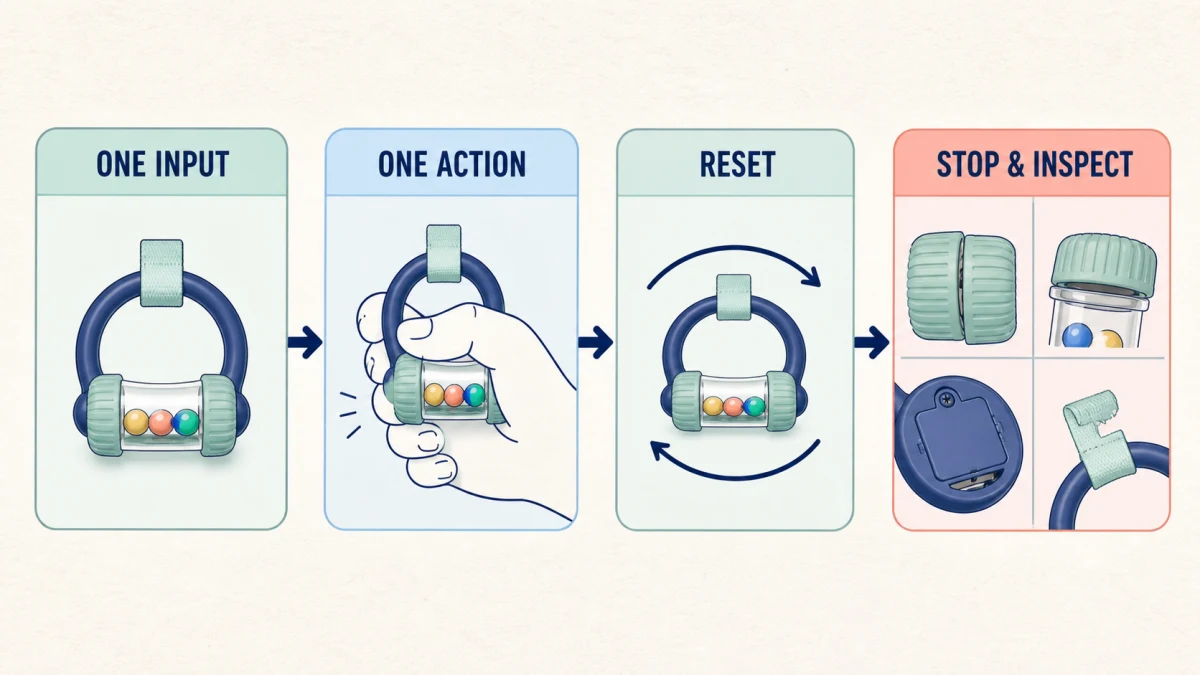
Name the input
“Stimulating” is too vague. Write what changes: the surface feels rough, a sealed element makes a soft sound, a shape rolls slowly, or pressing creates resistance. If the description needs a therapeutic outcome to sound useful, the actual play may be unclear.
Name the baby’s action
Can the baby reach, hold, shake, press, turn, pass, or look? The action should not require a precision grip, sequence, or rule that belongs to a later stage. An adult can model the action, but the product should not depend on a performance.
Name the reset
The object returns to a ready state after it rolls, compresses, opens, or makes a sound. A quick reset supports repetition. If an adult must retrieve small parts or refill a container, the product may be unsuitable for the setting even before safety is considered.
Name the stop condition
State when play ends: a seam opens, a cap shifts, a surface peels, a sound changes, liquid appears, a battery cover is damaged, cleaning changes the texture, or the manufacturer’s age/use boundary no longer matches. “Still works” is not enough after damage.
High-Risk Checks for Baby Sensory Products
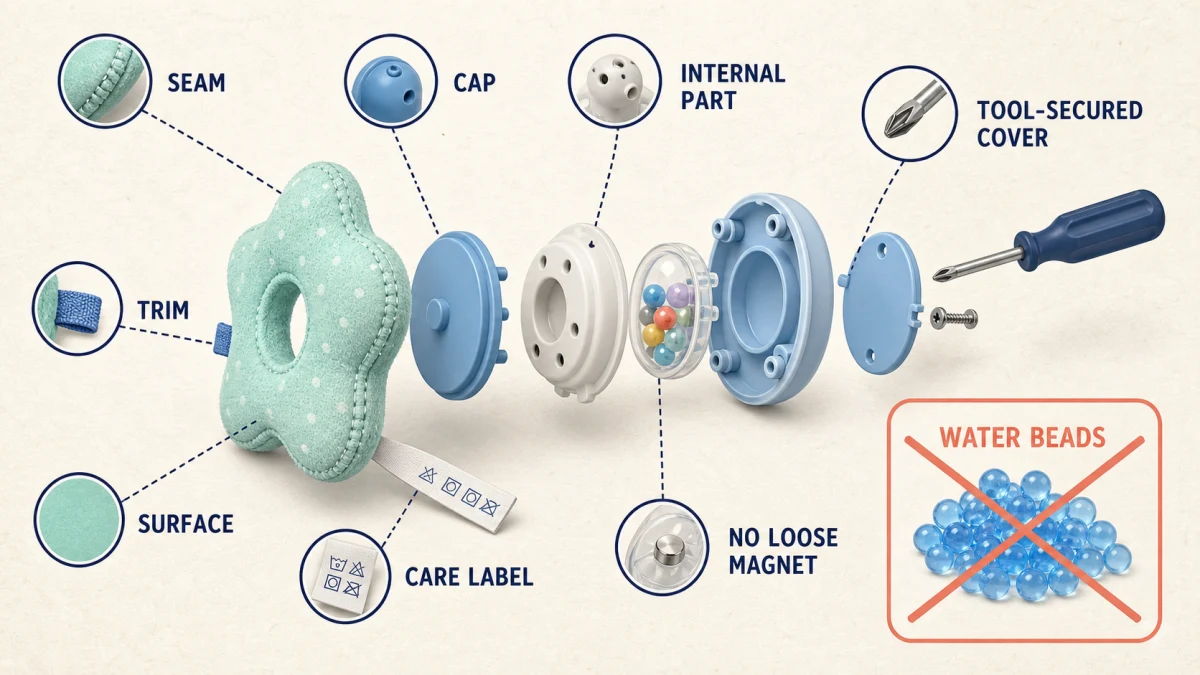
Small parts and changing parts
CPSC’s small-parts guidance explains the U.S. ban for certain products intended for children under three and the role of the small-parts cylinder. The rule includes pieces that can break off during applicable use-and-abuse testing. A parent’s visual guess or improvised tube does not prove compliance.
Inspect the whole object, not just the obvious play pieces. Eyes, wheels, fabric tabs, zipper pulls, squeakers, bells, pegs, decorative patches, caps, and fasteners can become different hazards if they loosen.
Button and coin cells
The CPSC button-cell and coin-battery safety center states that toy compartments for these batteries require a secure closure that needs a screwdriver, coin, or tool to open. If a battery cover or compartment is damaged, stop using the product and follow current official/manufacturer direction. Never let a child handle a loose battery.
Magnets
Loose or separable magnets are a critical stop condition. The CPSC magnets center documents serious ingestion hazards and current warnings. Do not keep using a baby toy after a magnet shifts, becomes accessible, or disappears.
Water beads and loose expanding media
Do not treat water beads as an infant sensory option. CPSC’s current Water Beads Information Center urges parents and caregivers to remove water beads from environments with children and explains that dry beads can be hard to see and may expand if swallowed. Follow the emergency direction on that page if exposure is suspected.
Cleaning Is a Product Fact, Not a Universal Method
“Washable” is incomplete. Verify whether the manufacturer permits wiping, hand washing, machine washing, immersion, boiling, steam, or no water near a component. Water can enter a seam or hollow body; heat or chemicals can change a coating, adhesive, foam, mirror film, printed surface, or electronic enclosure.
Use this sequence:
- Read the current care instructions for the exact model.
- Remove or secure components only as instructed.
- Use the stated method and product.
- Dry for the stated time and orientation.
- Inspect the complete toy after cleaning.
- Retire it if cleaning exposes damage or changes the construction.
Do not create an editorial cleaning recipe when the material and construction are unknown.
A Before-Every-Use Inspection
- [ ] Exact product and age grade still match the intended child and use.
- [ ] No seam, trim, film, patch, cap, plug, wheel, eye, or fastener has moved.
- [ ] No crack, puncture, leak, exposed fill, sharp area, or sticky/degraded surface is present.
- [ ] Battery compartment remains tool-secured and undamaged, if applicable.
- [ ] No magnet or weighted component is loose, missing, or newly detectable.
- [ ] Sound and movement are unchanged; there is no rattle from a broken internal part.
- [ ] The toy was cleaned exactly as instructed and is fully dry.
- [ ] The exact model has been checked against current CPSC recalls and warnings.
What This Guide Can and Cannot Decide
This framework can help an adult compare inputs, identify model facts to request, and build an inspection routine. It cannot confirm chemical composition, regulatory compliance, test results, or durability for an unseen product. The CPSC toy-safety overview makes clear that different product features trigger different requirements and that manufacturers/importers are responsible for identifying applicable sections.
It also cannot prescribe sensory input, treat a developmental condition, or determine whether a baby is meeting milestones. Sensory preferences vary, and distress may have many causes. Ask a pediatrician about developmental or health concerns. If a therapist recommends equipment, use the exact professional and manufacturer instructions rather than replacing them with this guide.
Frequently Asked Questions
What sensory toys are suitable for a newborn?
This article does not provide a newborn product list. Follow the exact age grade and pediatric guidance. Simple caregiver interaction and age-appropriate visual or sound experiences do not require adding an unverified object to sleep or feeding spaces.
Are soft sensory toys automatically safe for babies?
No. Softness does not verify piece size, seams, filling, coatings, attachments, magnets, batteries, cleaning, or intended use. Verify the whole construction and follow the age label.
Can a baby use a sensory toy labeled for toddlers?
Do not move below the manufacturer’s minimum age because the toy looks simple. The age grade may reflect small parts, strength, use pattern, batteries, or other risks not visible in a photo.
Are water beads safe with close supervision?
No recommendation in this guide supports that use. Current CPSC guidance urges removing water beads from environments with children. Use a different, age-graded sensory experience.
How often should baby sensory toys be inspected?
Inspect before use and after any drop, hard impact, cleaning, or unusual change. Follow stricter manufacturer directions if provided. A scheduled check does not replace immediate action when damage appears.
Choose the Next Step
Start with one input and one action, then use the Toy Finder to narrow by age and setting. Read the live sensory and squishy-toy safety guide for seam, filling, cleaning, and retirement questions. Finally, use Find Best Toys’ safety and source policy to distinguish verified facts from unknowns.
How This Guide Was Prepared—and Its Limits
Find Best Toys Editorial prepared this guide from the dated official sources listed below. It provides general, category-level decision support, names no ranked or hands-on-tested model, and does not replace product instructions or professional advice. No named specialist reviewer is currently listed. Verify the exact product's age label, warnings, instructions, condition, and current recall status before use. We will update this guide when cited guidance or relevant product evidence changes.
References
- CDC: Milestones by 1 Year
- CPSC: Toy Safety
- CPSC: Small Parts Ban and Choking Hazard Labeling
- CPSC: Button Cell and Coin Batteries
- CPSC: Magnets
- CPSC: Water Beads
- CPSC: Recalls and Product Safety Warnings