


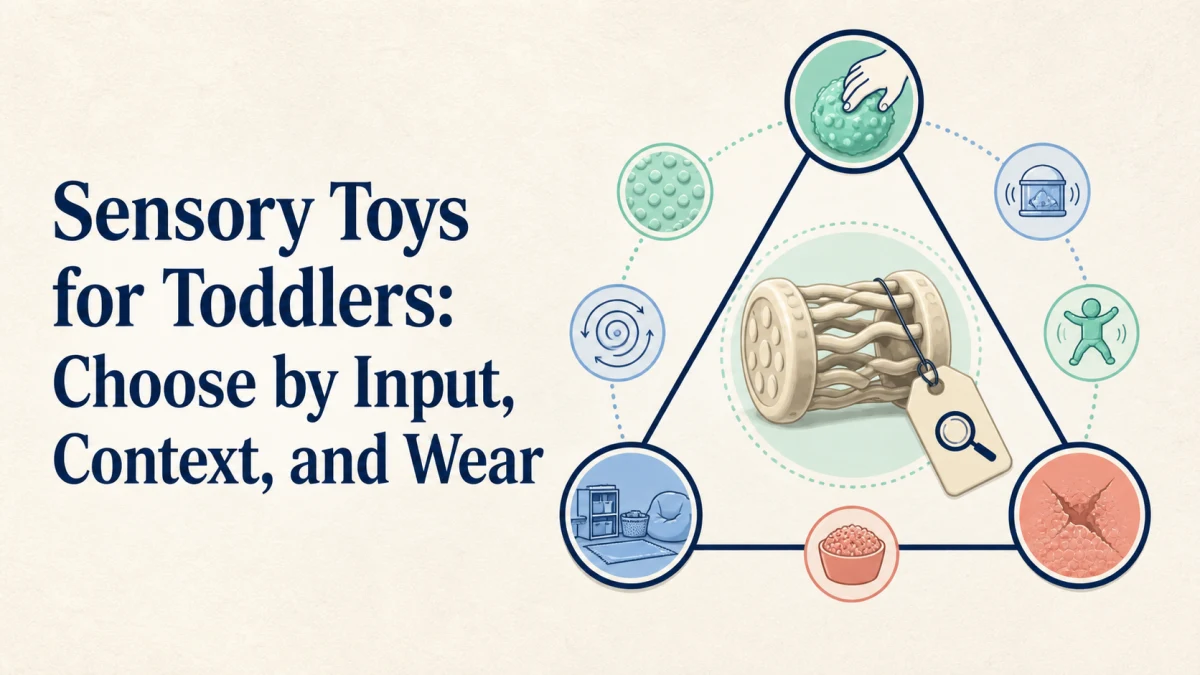
Choose sensory toys for toddlers by three things: the observable input, the place the toy will be used, and how its construction changes with wear. A quiet spinner, resistant squeeze object, textured matching activity, movement toy, and messy play material solve different needs. “Sensory” is not a promise to calm, focus, or treat a child. Follow the exact age grade and warnings, avoid water beads, inspect after use and cleaning, and stop at any failure. This is a decision guide, not a tested product list.
Key Takeaways
- Describe the input and action: press, rub, spin, sort, carry, rock, listen, or move.
- Match noise, portability, mess, rolling parts, social expectations, and supervision to the setting.
- Toddlers change quickly; revisit mouthing, throwing, opening, climbing, and force rather than relying on a birthday alone.
- Inspect skins, seams, caps, attachments, magnets, batteries, wheels, and surfaces for wear.
- Therapeutic or diagnostic claims require evidence and qualified review; this guide makes none.
Separate Input from Outcome
An input is observable: slow resistance, a ridged surface, a click, a spinning motion, a weighted push, a soft brush, or a rolling object. An outcome such as “calms,” “improves attention,” or “regulates” depends on the individual and context and can imply a medical or developmental benefit.
Write category descriptions in two parts:
The toy offers [input] through [action]. It may suit [setting] if its noise, size, cleaning, and supervision requirements fit.
For example: “This category offers repetitive finger motion through a contained spinner and may suit seated travel if it remains quiet, cannot roll away, and is age-graded for the child.” That is more useful than “a calming travel toy.”
The CDC age-two and age-three pages provide examples of changing play, language, movement, and hand use. Use them as context for observation, not proof that a product develops a skill. CDC states its milestone materials do not replace validated screening.
Build the Shortlist by Input Family
| Input family | Example actions | Context questions | Common failure points | Verify |
|---|---|---|---|---|
| Tactile surface | Rub, trace, match, press | Is the surface washable? Will it collect debris? | Peeling texture, loose trim, degraded coating | Material, adhesive/attachment, care, retirement instructions |
| Resistance or squeeze | Compress, stretch, push | Is it intended for this age and use? Is mouthing likely? | Split skin, open seam, valve shift, exposed filling | Complete material/filling statement, age grade, care, failure response |
| Repetitive mechanism | Spin, click, slide, open, close | Is the sound acceptable? Can a part trap or pinch? | Loose cap, exposed mechanism, missing fastener | Small parts, points/edges, mechanism enclosure, noise |
| Visual movement | Roll, wobble, watch contained elements | Can it roll into traffic or under furniture? | Cracked window, escaped insert, plug failure | Containment, impact resistance information, dimensions |
| Whole-body input | Push, carry, balance, crawl, throw | Is the space and surface suitable? What supervision is needed? | Instability, wheel/axle failure, collision, climb misuse | Intended surface, load/age limits, stability, protective guidance |
| Messy material play | Scoop, pour, mold, transfer | What can be swallowed, inhaled, spilled, or cross-contaminated? | Unlisted material, scattered small media, degraded storage | Exact contents, age and use directions, hygiene, disposal |
The broad Sensory and Fidget Hub owns category discovery. The sensory-play skill page provides another route into the collection. This guide owns toddler-specific choice and wear decisions.
Match the Toy to the Setting
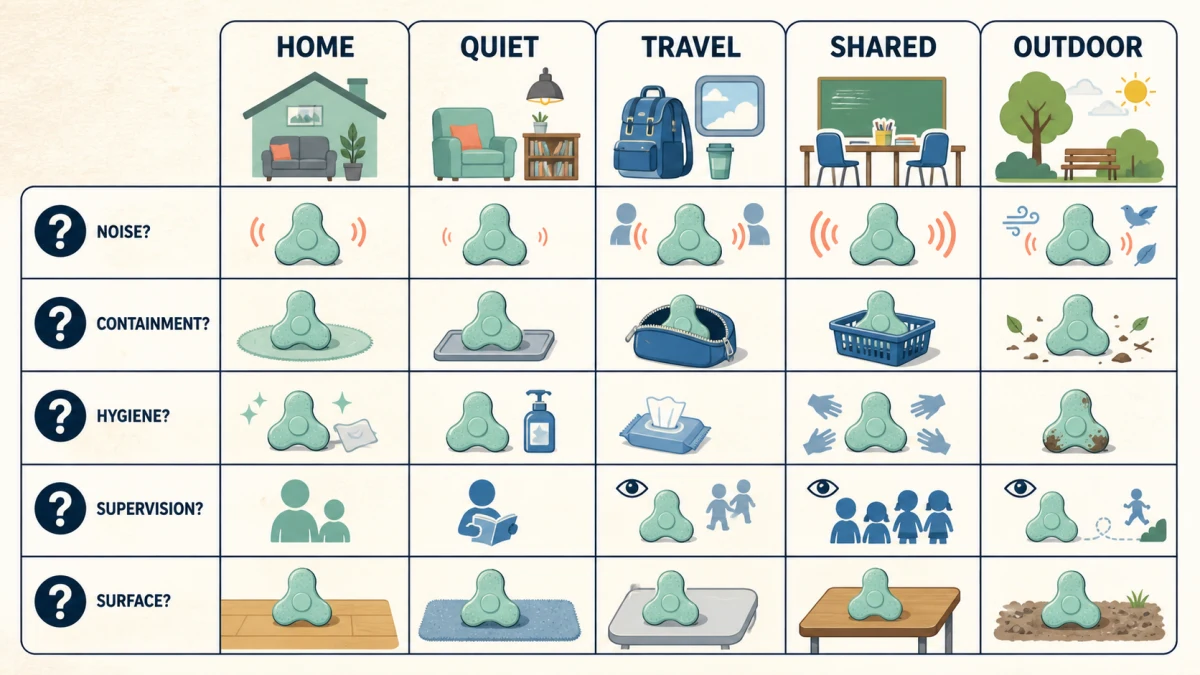
Home floor play
Rolling distance, furniture gaps, younger siblings, pets, and cleaning matter. A toy that is easy to retrieve and inspect may be more useful than a multi-piece bin that scatters through the room.
Quiet time
“Quiet” needs verification. Check clicks, motor hum, music, hard parts striking a table, and the child’s own use. The live quiet-time collection can organize options, but no category can guarantee silence or calm.
Travel and waiting
Choose a contained object that does not roll away, shed parts, require a tray full of loose accessories, or become impossible to clean. Consider whether the toy is appropriate in a vehicle; a caregiver must never use a toy recommendation to weaken car-seat or transport safety instructions.
Shared or classroom play
Ask how many children can use the material, whether parts can be counted, how cleaning works between users, and whether the sound distracts others. A personal sensory plan belongs with the child, family, educators, and relevant professionals—not a generic product label.
Outdoor play
UV exposure, grit, water, temperature, and harder impacts can change materials. Use only in intended conditions, clean as directed, and inspect again before returning the item indoors.
Use the Observe–Offer–Check Loop
Observe
Notice what the child seeks or avoids without diagnosing it: repeated pushing, rubbing a texture, carrying heavy objects, watching rotation, making sounds, or moving vigorously. Also note where and when it occurs.
Offer
Offer one safe, age-graded way to explore that action. Keep the goal modest: access to the input, not a promise to change behavior. An adult can model and remain nearby without forcing continued use.
Check
Watch the child’s use and the toy’s construction. Does the child bite, twist, throw, pry, climb on, or disassemble it? Does the surface, sound, seam, or mechanism change? Stop when the use falls outside instructions or the condition changes.
Revise
Change the setting, duration, object, or adult support. The child is not required to like a texture or persist with an input. Preference and tolerance can change.
High-Risk Exclusions and Checks
Water beads are not a toddler option
CPSC’s current Water Beads Information Center urges parents and caregivers to remove water beads from environments with children. It explains that dry beads can be extremely small, scatter, and expand after ingestion. Do not turn “close supervision” into an editorial workaround.
Small parts require more than a glance
The CPSC small-parts guidance covers products intended for children under three and includes pieces released during applicable testing. Follow the exact age grade. Consider younger household members even when the intended toddler is over three.
Batteries and magnets are stop conditions when access changes
For button or coin cells, CPSC says toy compartments require a secure closure opened with a tool. Review the current button-cell guidance. For magnets, use the CPSC magnet safety center. Stop if a cover, magnet, or fastener is damaged, loose, missing, or accessible.
Cleaning and Retirement Checklist
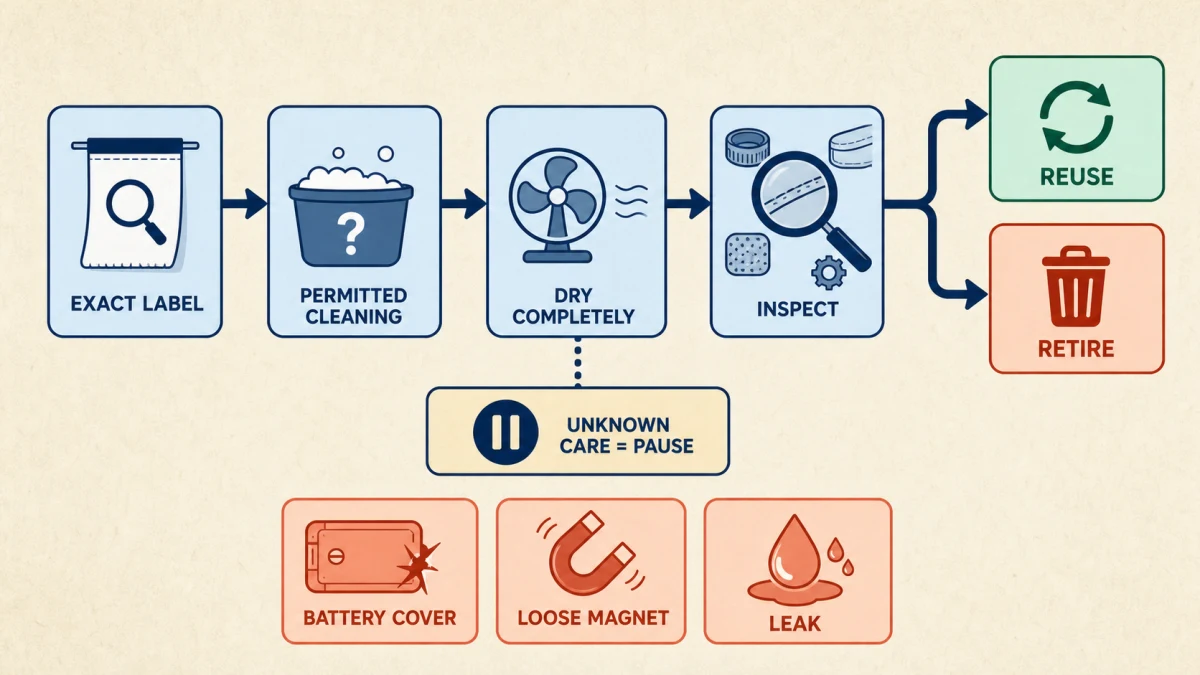
- [ ] The exact model’s care method is available and followed.
- [ ] No immersion is used unless the manufacturer permits it.
- [ ] The toy dries completely in the instructed orientation.
- [ ] Cleaning has not made a surface sticky, brittle, cloudy, swollen, or loose.
- [ ] Seams, valves, plugs, windows, caps, trim, wheels, and fasteners remain unchanged.
- [ ] No filling, gel, liquid, powder, bead, magnet, or battery is accessible.
- [ ] No new rattle, sharp point, burr, crack, or exposed wire/mechanism appears.
- [ ] The toy is retired when the manufacturer’s stop condition or any critical failure appears.
- [ ] The exact model is checked against current CPSC recalls and warnings.
The live sensory and squishy-toy safety guide owns detailed squeeze-product failure and cleaning intent. Use it rather than duplicating that article here.
Suitable, Unsuitable, and Still Unknown
Suitable when…
The product is age-graded for the child, its input and construction are clearly described, its use fits the setting, the adult can inspect it, and the child can stop or move away.
Unsuitable when…
It contains water beads; the age grade is older; critical material or filling information is missing; loose parts, batteries, or magnets can become accessible; the setting conflicts with instructions; or the product is marketed as treatment without appropriate evidence.
Still unknown until verified…
Chemical composition, applicable certification, actual noise level, impact durability, seam strength, wash durability, recall status, and whether a named model creates the described input. Keep unknowns visible.
Frequently Asked Questions
What are sensory toys used for with toddlers?
They can provide an observable input or action such as texture, resistance, movement, sound, sorting, or whole-body play. This guide does not claim they treat a condition or produce a developmental outcome.
Are sensory toys only for autistic children?
No category of play belongs to one diagnosis. However, individualized sensory or therapeutic recommendations should come from the child, family, and qualified professionals—not a generic shopping guide.
What makes a sensory toy quiet?
Check the product and real use: internal clicks, motors, music, hard parts on a table, and rolling can all create sound. “Quiet” is a model-level, context-dependent claim.
Can toddlers use homemade sensory bins?
This guide does not certify a recipe. Materials, container, pieces, hygiene, ingestion, allergy, younger-sibling access, and supervision all require specific assessment. Water beads are excluded under current CPSC guidance.
When should a sensory toy be thrown away?
Follow manufacturer instructions and retire it at any critical change: split seam, leak, loose/missing part, accessible magnet or battery, damaged mechanism, sharp area, degraded material, or cleaning damage.
Choose the Next Step
Write one input and one setting, then use the Toy Finder to narrow the category. Review Find Best Toys’ safety and source policy, and inspect the exact model rather than treating a collection label as evidence.
How This Guide Was Prepared—and Its Limits
Find Best Toys Editorial prepared this guide from the dated official sources listed below. It provides general, category-level decision support, names no ranked or hands-on-tested model, and does not replace product instructions or professional advice. No named specialist reviewer is currently listed. Verify the exact product's age label, warnings, instructions, condition, and current recall status before use. We will update this guide when cited guidance or relevant product evidence changes.
References
- CDC: Milestones by 2 Years
- CDC: Milestones by 3 Years
- CPSC: Toy Safety
- CPSC: Small Parts Ban and Choking Hazard Labeling
- CPSC: Button Cell and Coin Batteries
- CPSC: Magnets
- CPSC: Water Beads
- CPSC: Recalls and Product Safety Warnings