


# Best Educational Toys for 3-Year-Olds
The best educational toys for 3-year-olds make an interesting action easy to start and leave room for the child to change the plan. Think sturdy building pieces, pretend-play props, simple puzzles, art materials, musical instruments, and matching games—not a product that merely says “educational” on the box.
Editorial note: This draft explains the selection framework. Do not publish a ranked product list until the named products have completed Play Atlas's hands-on evidence and safety workflow.
Key takeaways
- Choose for the action a child can perform, not the learning claim on the package.
- Strong options invite language, pretend play, construction, matching, movement, or creative variation.
- A useful challenge has an obvious starting point and more than one satisfying next step.
- Count adult setup, cleanup, noise, storage, and replacement pieces as part of the product's value.
- Follow the current age label and inspect small parts, magnets, batteries, sharp points, and damage.
- No single toy is necessary for a child to reach a milestone.
What are the best educational toys for 3-year-olds?
The best educational toys for most 3-year-olds are open-ended materials and simple games that support conversation, pretend play, fine-motor control, problem solving, and movement. A good toy fits the child's current abilities, provides understandable feedback, and can be used in more than one way without demanding constant adult instruction.
The CDC's three-year milestone examples include joining other children in play and taking part in short back-and-forth conversations. These are useful observations, not a shopping checklist and not a reason to rush a child. See the CDC's current three-year milestone examples and discuss developmental concerns with a qualified professional.
How did we select the toy types in this guide?
We begin with observable play. What does the child actually do—build, fit, sort, name, negotiate, carry, draw, act out, or make a sound? We then check four practical questions:
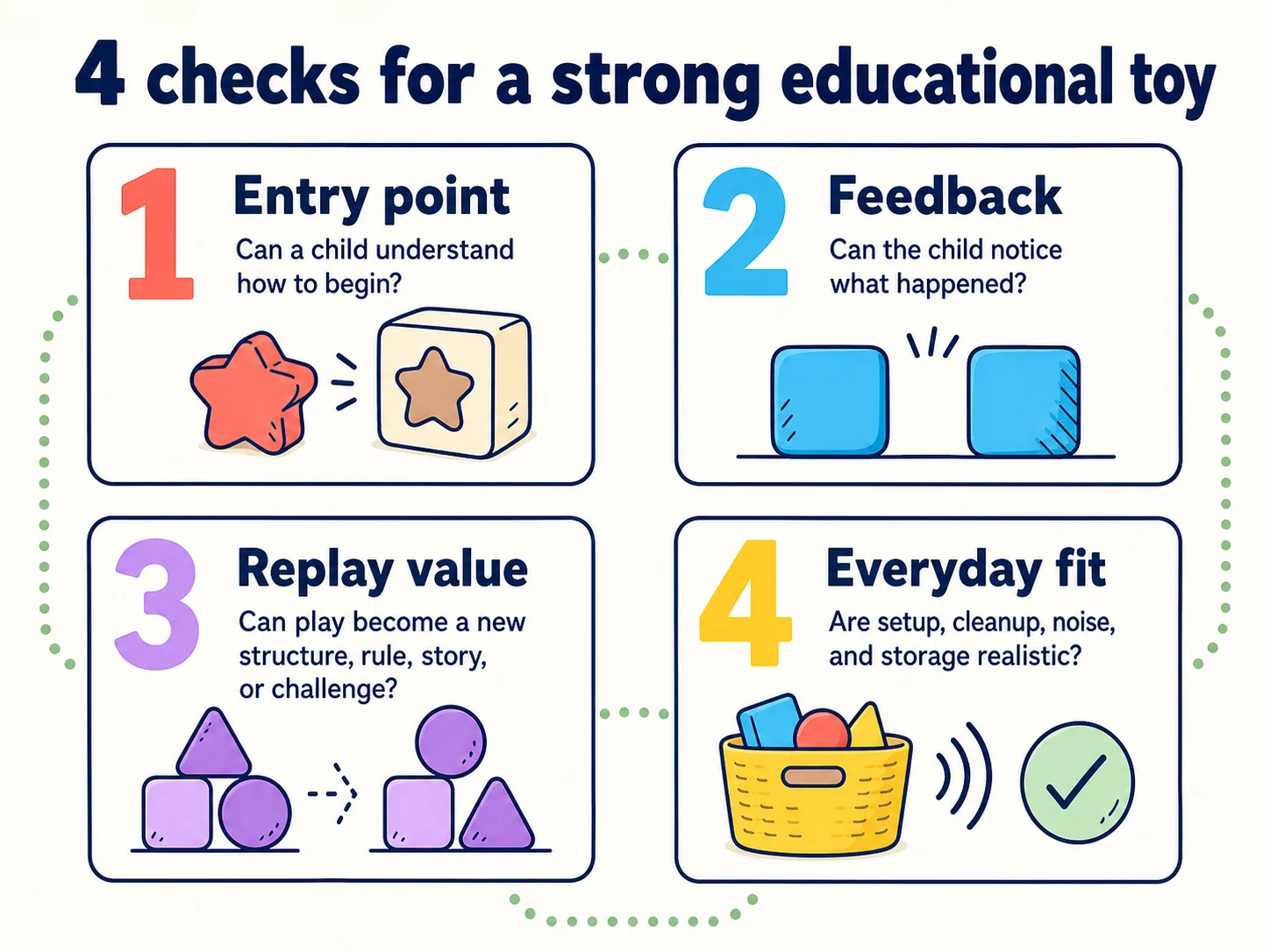
- Entry point: Can a child understand how to begin?
- Feedback: Can the child notice what happened without a flashing score screen?
- Replay value: Can the activity become a new structure, rule, story, or challenge?
- Everyday fit: Is the setup, cleanup, noise, and storage realistic for the home?
The American Academy of Pediatrics advises families to look beyond “educational” marketing and favors toys that support real interaction and flexible play. Its toy-buying guidance also stresses matching a toy to a child's developmental skills and abilities.
Which toys support language and pretend play?
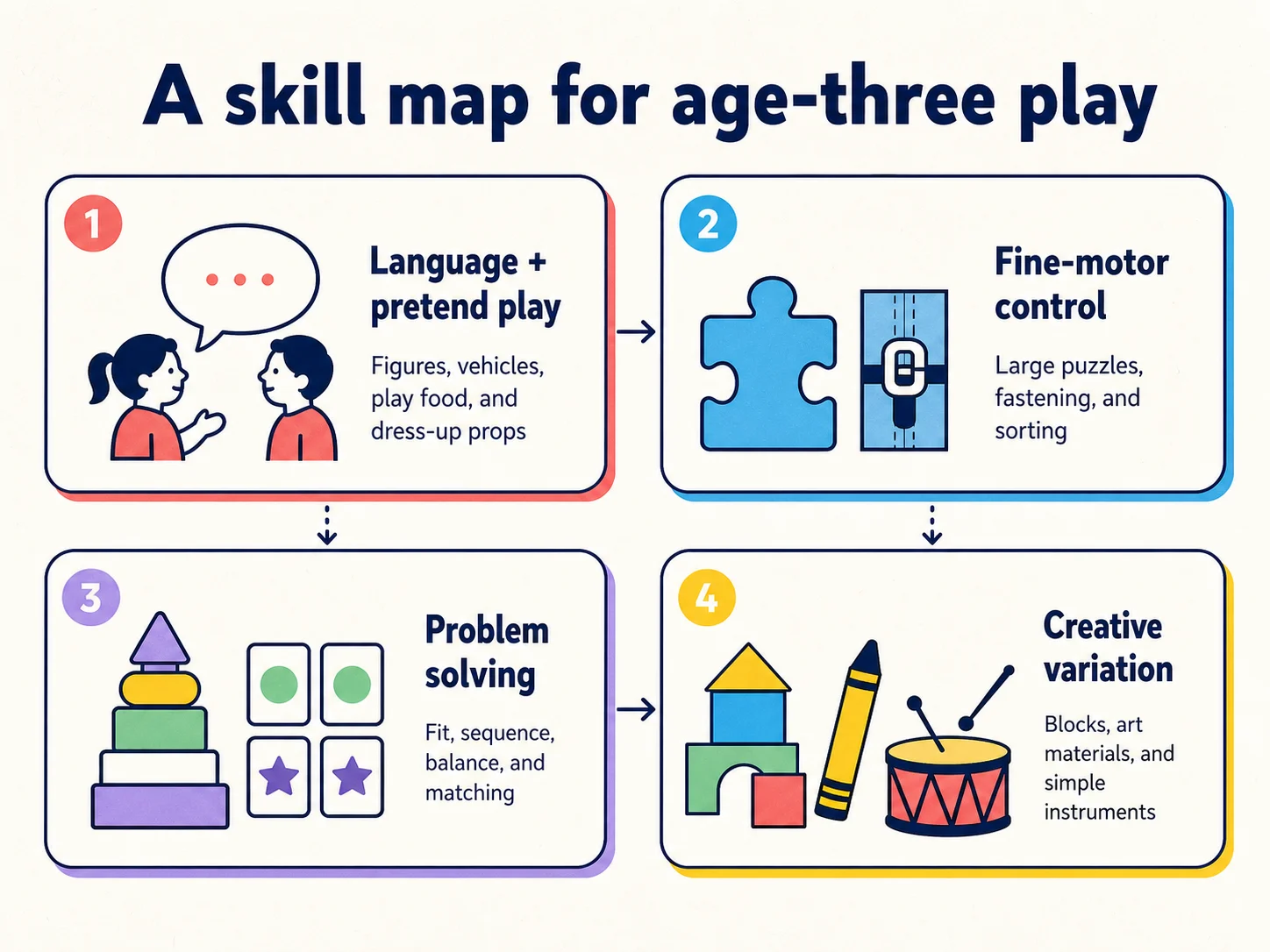
Small-world figures, dolls, vehicles, play food, dress-up pieces, and simple household props can create language-rich play because the child supplies the story. The value is not in a recorded vocabulary list. It appears when a child names characters, explains an event, repeats a familiar routine, or invites another person into the scene.
Look for pieces that are large enough for the intended age, easy to identify, and stable during play. A compact set of well-chosen props is often more usable than a crowded kit with many single-purpose accessories.
For a product roundup, record whether figures stand reliably, whether doors or moving parts trap fingers, whether paint rubs off, and whether the set introduces small detachable parts after ordinary use.
Which toys build fine-motor control and problem solving?
Large-piece puzzles, construction sets, lacing or fastening activities, and sorting materials can create manageable problems with visible feedback. The ideal resistance is neither effortless nor so demanding that every attempt ends with adult rescue.
Useful testing questions include:
- Can the child grip and release the pieces comfortably?
- Does the base slide, tip, or rotate during use?
- Can a wrong piece become stuck?
- Does the activity still work when the pieces are not arranged exactly as the adult expects?
- Can the child invent a second way to use the material?
Avoid presenting a puzzle or fine-motor toy as a treatment or as proof of intelligence. Describe the action and the observed difficulty instead.
Are building toys educational for 3-year-olds?
Building toys can be educational when they let a child test balance, connection, size, sequence, and imagination through repeated construction. The learning comes from the building process and conversation around it, not from a STEM badge.
For three-year-olds, check the manufacturer's age range and the dimensions of every piece. Products intended for children under three are subject to the federal small-parts ban; age-three products may still be unsuitable for a child who mouths objects or shares the space with a younger sibling. The CPSC explains the legal test in its small-parts guidance.
What should parents check before buying?
Read the full label, match the toy to the child who will use it, and inspect the product—not just the box photograph. Confirm the exact model, age grade, warnings, battery access, magnets, cords, projectile pieces, and cleaning instructions.
The CPSC states that toys intended for children 12 and under must be third-party tested and certified for applicable U.S. children's product safety rules. That does not mean every toy is suitable for every child or that damage cannot create a new hazard. Review the CPSC toy-safety requirements, then search the current recall database using the exact brand and model.
How should a “best” list be tested?
A credible list should publish the evidence behind its order. For each product, Play Atlas should record:
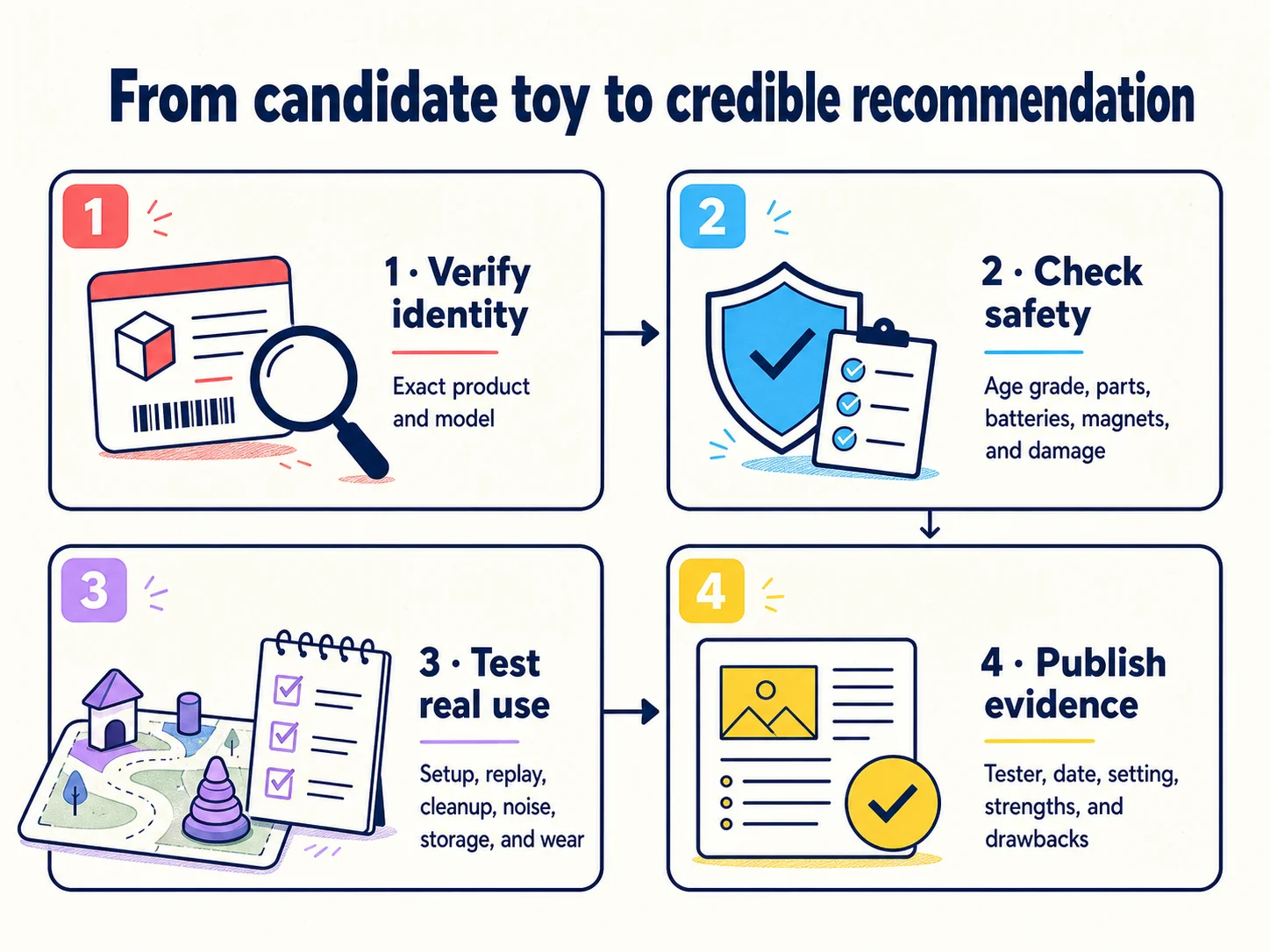
- exact product and model;
- sample source and any commercial relationship;
- tester, date, duration, and setting;
- easiest entry point and likely next challenge;
- setup, reset, cleanup, noise, and storage;
- visible wear, loose parts, battery access, and stability;
- strengths, drawbacks, and children for whom the product may be a poor fit.
Until that evidence exists, the honest output is a category guide—not a ranked verdict.
Frequently asked questions
Do electronic learning toys teach more?
Not necessarily. Electronic feedback can demonstrate cause and effect, but more features do not automatically create richer play. Compare how much the child does with how much the toy performs for them.
How many educational toys does a 3-year-old need?
There is no required number. A smaller, accessible collection that supports different kinds of play can be easier to use than an overfilled shelf. Rotate only when it helps the household; it is not a developmental rule.
What if my child does not use the toy as intended?
First check safety. If the new use is safe, it may reveal the child's real interest. If it creates a hazard, remove the product and offer a safer material for the same action.
The Play Atlas view
Choose a playable challenge, not a promise. Start with the Educational Toys hub, compare the Montessori selection guide, or use the Toy Finder to narrow the choice by age, skill, situation, and space.