


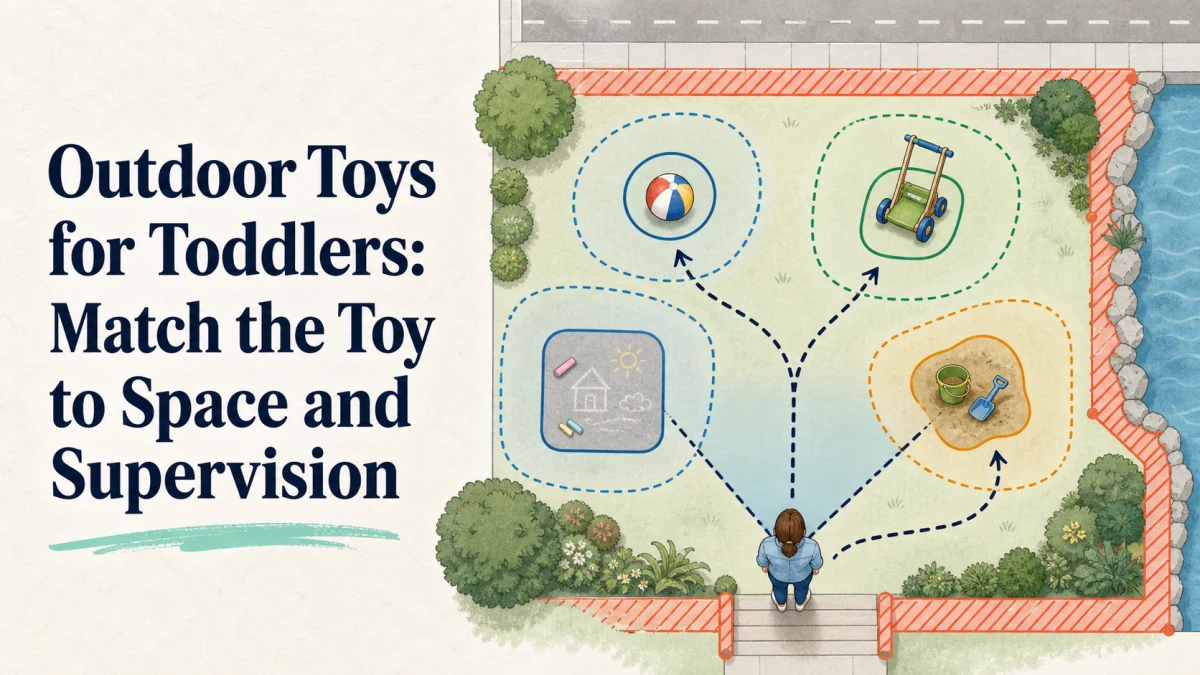
Choose outdoor toys for toddlers by the movement they invite and the real space around them. A ball needs a safe retrieval area; a push toy needs a suitable surface; sand tools need hygiene and storage; ride-on or climbing equipment needs model-specific clearance, setup, and supervision. Start with the child and site, then verify age grade, intended surface, dimensions, stability, warnings, assembly, weather care, and current recalls. This guide compares categories—it does not rank or claim to have tested products.
Key Takeaways
- Measure the active play area, not just the toy’s footprint.
- Match the movement—carry, roll, throw, push, pull, dig, balance—to current use and the surface.
- Plan adult position, sight lines, retrieval, boundaries, and younger-child access before buying.
- Weather, grit, water, UV exposure, and storage can change a product; inspect after outdoor use.
- Treat water play, ride-ons, climbing, projectiles, and public playgrounds as separate risk contexts with specific instructions.
Start with Movement, Not a Product Category
Toddlers may run, kick, roll, carry, scoop, climb, imitate, and join other children in changing ways. The CDC age-two and age-three pages provide examples of movement and play, while warning that milestone materials are not a substitute for validated developmental screening.
Use observation, not a checklist score:
- Does the child seek pushing, carrying, throwing, digging, or chasing?
- Can they stop, turn, and release an object with current control?
- Do they mouth materials or use equipment in unexpected ways?
- Can the adult stay close enough for the product and location?
- What happens when another child enters the play?
Do not buy an older or more difficult product to accelerate a milestone. Follow the exact age grade and intended use.
Map the Site Before You Shop
Footprint
Record the space the product occupies at rest, including anchors, stabilizers, handles, and open doors or ramps.
Active envelope
Add the distance a child, projectile, vehicle, swing, rolling object, or splash can travel. Include approach, exit, and retrieval. A compact toy may create a wide movement zone.
Surface
Concrete, grass, soil, sand, decking, indoor flooring, and public-playground surfacing behave differently. Use a product only on its intended surface and follow installation instructions. Do not infer impact protection from a material’s appearance.
Boundaries
Identify roads, driveways, water, steps, grills, gates, pets, garden tools, drainage, and blind corners. A toy that rolls, launches, or encourages chasing may be wrong for a site even if it fits physically.
Adult position
Decide where the supervising adult can stand and still see the child, equipment, other children, and boundaries. “Supervision required” is not a complete plan until distance and sight lines are practical.
The live outdoor-play collection owns category browsing. The existing outdoor toys for kids guide owns the all-age space/material decision. This article narrows the task to toddler movement and supervision.
Compare Outdoor Play Families
| Play family | Main action | Space question | Adult job | Weather/storage question | Verify |
|---|---|---|---|---|---|
| Balls and rolling objects | Roll, kick, throw, retrieve | Where can the object and child travel? | Set boundaries; prevent chasing into hazards | Can it be cleaned, dried, and checked for splits? | Size, material, inflation instructions if any, intended age |
| Push and pull | Walk, steer, carry, tow | Is the surface level and route contained? | Stay close; manage slopes and collisions | Do wheels/axles trap grit or retain water? | Stability, wheel/axle construction, cord length, intended surface |
| Digging and sand play | Scoop, pour, shape, transfer | Is the material and area maintained and free of hazards? | Prevent throwing/mouthing; manage shared tools | How are tools cleaned and dried? | Piece size, edges, handles, material, site rules |
| Chalk and large art | Mark, trace, draw, wash away | Is the surface permitted and away from traffic? | Verify material and prevent mouth/eye misuse | Does storage keep materials dry and identifiable? | Exact material, age grade, cleanup instructions |
| Targets and simple throwing games | Aim, toss, take turns | Is there a clear throw and retrieval lane? | Control direction, distance, and other people | Can parts warp, split, or retain water? | Projectile/part size, intended distance, setup, warnings |
| Ride-on or balance equipment | Sit, propel, steer, balance | Are slope, surface, clearance, and barriers suitable? | Follow model-specific supervision and protective instructions | Where will it dry; what hardware needs inspection? | Age/size limits, assembly, stability, hardware, protective guidance |
| Fixed climbing or play equipment | Climb, step, slide, hang | Is installation and surrounding use zone compliant with instructions? | Continuous site-appropriate supervision | How are anchors, fasteners, surfaces, and wear maintained? | Exact standard/instructions, installation, surfacing, clearances, local requirements |
The table does not make these categories equivalent. A ball is not a substitute for climbing equipment, and a backyard product is not public playground equipment.
Use the SPACE Decision Framework
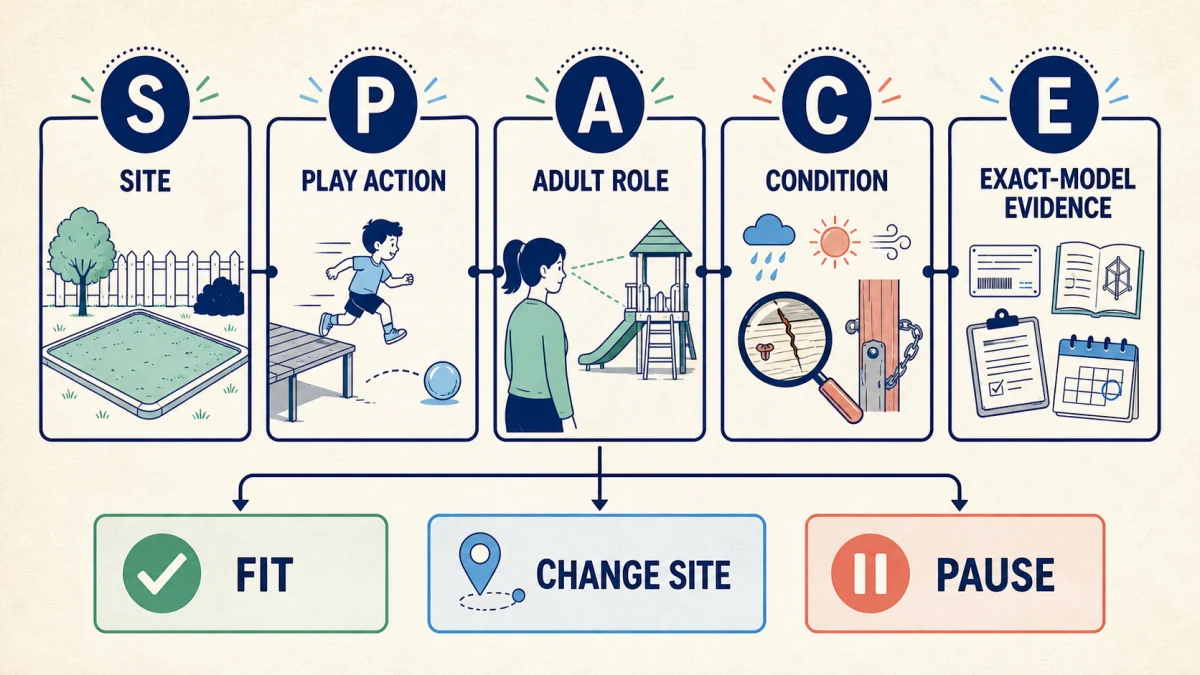
S — Site
Map surface, slope, boundary, weather, traffic, water, and other users.
P — Play action
Name what moves and how far. Include the child, toy, loose parts, and other children.
A — Adult role
Define assembly, close supervision, boundary control, teaching, retrieval, cleanup, and inspection. Reject a product when the required adult role cannot be sustained.
C — Condition over time
Outdoor exposure can alter fasteners, plastic, coatings, fabric, cords, wheels, and surfaces. Follow maintenance instructions and stop at cracks, sharp areas, instability, loose hardware, stretched cords, missing caps, or other changes.
E — Exact model evidence
Verify dimensions, age/size limits, included hardware, anchors, intended surface, protective guidance, assembly, maintenance, warnings, and current recall status. A category photo cannot answer these questions.
Public Playground Guidance Has a Specific Scope
The CPSC’s Public Playground Safety Handbook is current public-playground guidance for purchasers, operators, designers, and others evaluating public playground environments. It discusses site, equipment, layout, surfacing, installation, inspection, and maintenance. The handbook also explains that its recommendations are guidance and that state, local, insurer, or other requirements may apply.
Do not use the handbook as proof that a backyard toy is installed correctly or that a public site is hazard-free. Follow the exact equipment instructions, posted rules, local requirements, and site owner’s maintenance information. If equipment is damaged or the use zone is obstructed, leave and report it to the responsible operator.
Water-Adjacent Play Needs a Separate Decision
This guide does not provide pool, flotation, drowning-prevention, or water-supervision guidance. A toy does not make water safer, and the word “aquatic” or a colorful product photo is not evidence of flotation or protective performance. For any water-adjacent product, verify the exact warning, intended setting, adult-supervision requirement, and current official guidance for that setting before publication or use.
Do not let a general outdoor-toy list blur pool, beach, bath, sprinkler, and dry-yard contexts. If Find Best Toys later names a water product, it needs a separate high-risk evidence review.
Before, During, and After Play
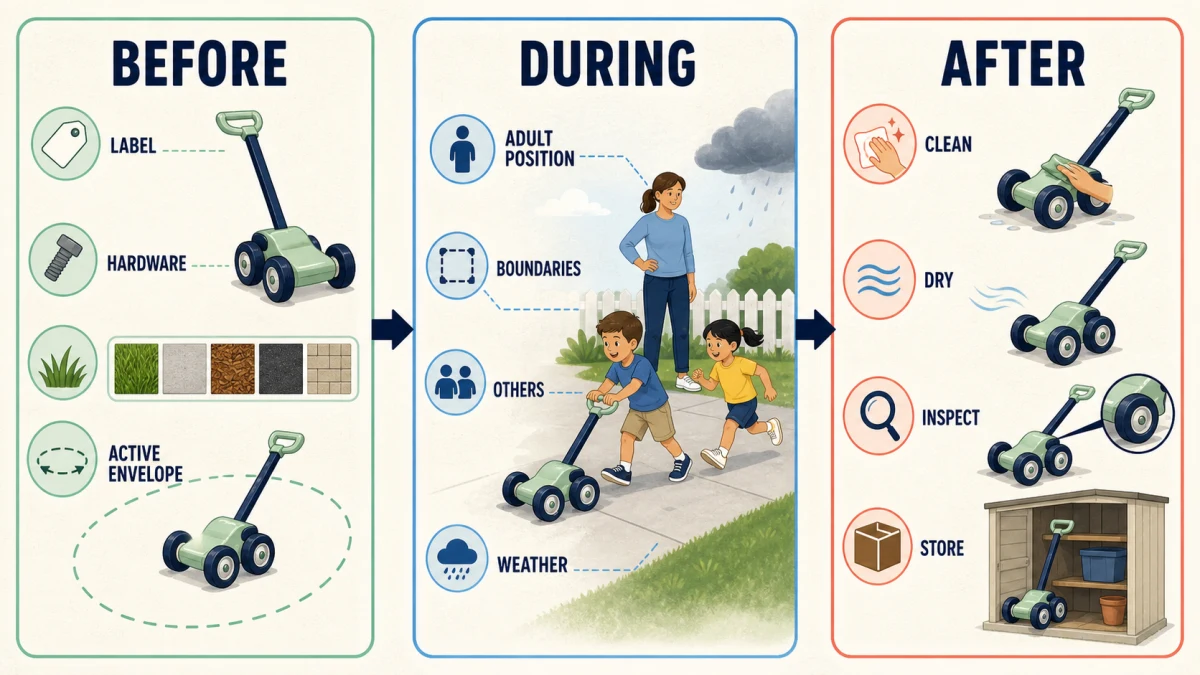
Before
- Confirm exact model, age/size limits, assembly, intended surface, and warnings.
- Check anchors, fasteners, wheels, cords, handles, seams, caps, inflation, and stability as applicable.
- Clear the active envelope and retrieval route.
- Check the exact model in CPSC recalls and product safety warnings.
During
- Stay in the position required by the child, product, and site.
- Stop if the use changes to climbing, throwing, towing, standing, or riding outside instructions.
- Reassess when more children join, an object moves toward a boundary, weather changes, or the surface becomes wet/slippery.
After
- Clean and dry exactly as instructed.
- Inspect for cracks, deformation, loosened hardware, exposed edges, worn cords, wheel/axle changes, trapped water, and missing pieces.
- Store away from traffic, standing water, heat sources, and access by younger children as applicable.
Suitable, Unsuitable, and Unverified
Suitable for consideration
The movement fits the child now, the active envelope fits the site, supervision is practical, exact-model facts are available, and condition can be inspected and maintained.
Unsuitable for this site
The object can roll or launch beyond a safe boundary; the surface or slope conflicts with instructions; protective setup is unavailable; the adult cannot maintain the required position; or storage/weather exposure will defeat maintenance.
Unverified
Dimensions, intended surface, assembly, stability, anchors, protective guidance, material durability, water use, or recall status is missing. Do not convert absence of information into a safety claim.
Frequently Asked Questions
What outdoor toys work in a small yard?
Choose by the active envelope, not the product footprint. Contained digging, large chalk, or a short rolling activity may fit better than equipment with a travel, swing, or run-out zone. Verify the exact site and model.
Are ride-on toys suitable for every toddler?
No. Follow the exact product’s age/size limits, intended surface, protective and supervision instructions, and consider the child’s current use. This guide does not approve a ride-on category.
Can I leave outdoor toys outside all year?
Only if the exact manufacturer instructions allow the exposure and maintenance. Weather can change materials and hardware. Storage indoors or under cover is not interchangeable with a product designed for continuous exposure.
Is public playground equipment appropriate for a two-year-old?
Use posted age/designation information, site rules, equipment condition, and close supervision. Public equipment and sites vary; this guide cannot approve a particular structure.
How often should outdoor toys be inspected?
Inspect before use, after hard impacts or weather events, and during the manufacturer’s maintenance schedule. Act immediately on any change; a calendar does not make damaged equipment usable.
Choose the Next Step
Draw the site and active envelope, then write the child’s preferred movement. Use the Toy Finder to narrow age and situation, and use Find Best Toys’ safety/source policy to record unknowns. The 2-year-old collection is useful for age context, but exact model and site still control the decision.
How This Guide Was Prepared—and Its Limits
Find Best Toys Editorial prepared this guide from the dated official sources listed below. It provides general, category-level decision support, names no ranked or hands-on-tested model, and does not replace product instructions or professional advice. No named specialist reviewer is currently listed. Verify the exact product's age label, warnings, instructions, condition, and current recall status before use. We will update this guide when cited guidance or relevant product evidence changes.
References
- CDC: Milestones by 2 Years
- CDC: Milestones by 3 Years
- CPSC: Public Playground Safety Handbook
- CPSC: Toy Safety
- CPSC: 2020 Age Determination Guidelines
- CPSC: Recalls and Product Safety Warnings
- American Academy of Pediatrics: How to Buy Safe Toys